
DISCOVER JAPAN SITES AI
Ask in your language. Get answers with context, not just keywords.
Welcome. What would you like to know?
Introduction: Why This Choice Matters
Japan continues to attract record numbers of international visitors, increasing demand for accommodation in popular destinations. During busy seasons, choosing where to stay can affect not only your budget but also how much time and energy you spend traveling.
Choosing between a hotel and an Airbnb is no longer just about finding the lowest nightly price. It affects your comfort, available space, luggage arrangements, privacy, and the actual cost of your stay.
Updated: October 2026
This guide compares hotels, Airbnb-style apartments, and traditional accommodation in Japan using current lodging-tax rules, practical cost examples, and travel logistics. Particular attention is given to families and groups sharing an entire property, where the rental price and the tax calculation may work differently.
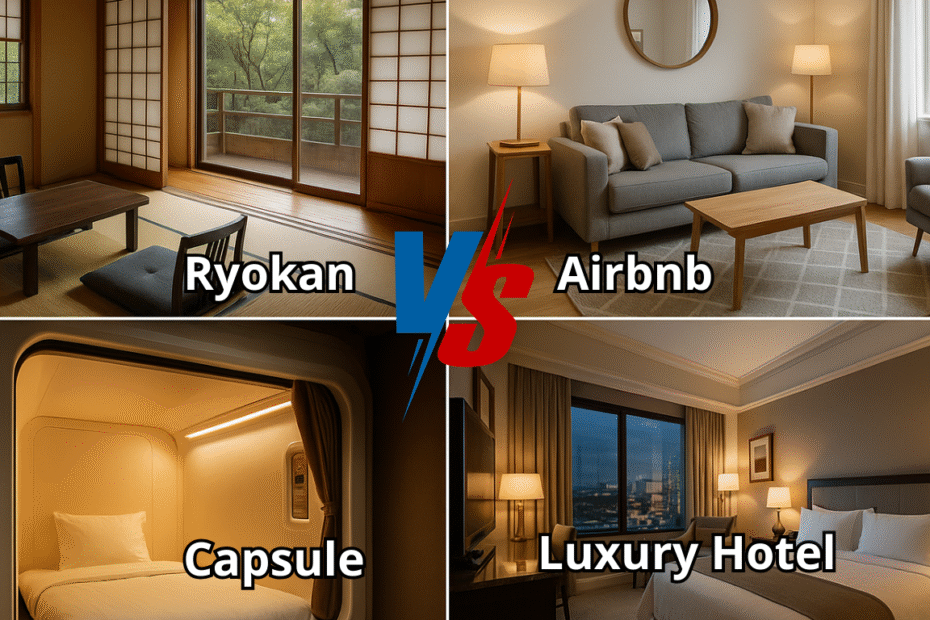
Hotels vs Airbnb: First Impressions
Hotels in Japan offer a relatively predictable experience: reception services, cleaning schedules, luggage assistance, and staff who can help when something goes wrong. The facilities and service level depend on the property, however, and not every hotel has a 24-hour reception desk.
Airbnb-style apartments can provide more living space, a kitchen, laundry facilities, and greater independence. They can be particularly attractive to families or groups planning to stay for several nights.
But the apparent price advantage can change when cleaning charges, booking fees, accommodation taxes, transport costs, and the number of guests are taken into account.
Comparison Snapshot — Hotels vs Airbnb (Japan 2026)
- Availability: Hotels generally operate year-round. Residential minpaku under Japan’s Private Lodging Business Act are subject to a 180-day annual limit, while other licensed accommodation categories follow different rules.
- Services: Hotels commonly offer staffed assistance and luggage storage. Apartments may use self check-in and provide fewer services during the stay.
- Space: Standard hotel rooms can be compact. Entire apartments may provide kitchens, laundry facilities, and shared living areas.
- Costs: Compare the complete reservation price, including applicable taxes, cleaning, service fees, and extra-person charges.
- Best fit: Hotels can be convenient for short stays; apartments and aparthotels deserve careful comparison for families, groups, and longer stays.
The True Cost of Staying in Japan
Many travelers compare the advertised nightly prices of hotels and Airbnb listings without checking the complete reservation total. That can lead to misleading conclusions.
For a fair comparison, use the same destination, dates, number of guests, and required sleeping capacity. Then compare the full cost of the stay.
The following examples are illustrative calculations, not live accommodation quotations. They show how fixed charges and group size can change the result. Actual prices depend on the property, season, platform, cancellation conditions, and local taxes.
Scenario 1: Two Nights in Tokyo — Solo Traveler or Couple
For a short stay, an apartment’s one-time cleaning charge can represent a large proportion of the booking. A conveniently located business hotel may therefore provide better value, particularly for travelers who need luggage storage or assistance after checkout.
Cost Reality — 2 Nights in Tokyo
Illustrative apartment booking for two guests
- Apartment rental: ¥8,000 × 2 nights = ¥16,000
- Cleaning fee: ¥10,000
- Illustrative platform fee: ¥3,640
- Illustrative total: ¥29,640
- Equivalent: ¥14,820 per night for the property, or ¥7,410 per person per night.
Illustrative hotel booking for two guests
- Room price including applicable consumption tax and standard mandatory charges: ¥12,000 × 2 nights = ¥24,000
- Tokyo accommodation tax: determined by the taxable room rate per person and the accommodation category.
- If the taxable accommodation rate is ¥6,000 per person per night, the current Tokyo tax is ¥0.
- Illustrative total: ¥24,000
- Equivalent: ¥12,000 per night for the room, or ¥6,000 per person per night.
In this example, the hotel costs ¥5,640 less overall. The result changes if different properties or dates are selected.
Tax note: As of October 2026, Tokyo’s metropolitan accommodation tax applies to the accommodation categories covered by its existing ordinance, principally hotels and ryokan. Expansion to minpaku is scheduled for April 2027. Do not automatically apply the hotel tax to every Airbnb listing in Tokyo.
Scenario 2: Seven Nights in Osaka — Family of Four
Now imagine a family of four staying in Osaka for a week. An entire apartment can become more attractive because its rental cost is shared by four people and a one-time cleaning fee is spread across seven nights.
The family also gains the potential convenience of a kitchen, washing machine, and common living space. But the advantage must still be checked against hotel family rooms or two hotel rooms with equivalent capacity.
Cost Reality — 7 Nights in Osaka (Family of Four)
Apartment example
- Entire apartment: ¥20,000 × 7 nights = ¥140,000
- Cleaning fee: ¥12,000
- Illustrative booking/platform charge: ¥21,280
- Osaka accommodation tax: ¥200 × 4 guests × 7 nights = ¥5,600
- Illustrative total: ¥178,880
- Equivalent: ¥6,389 per person per night, approximately.
Hotel example — two rooms for four people
- Two rooms at ¥12,000 each per night, with mandatory hotel charges and consumption tax included: ¥24,000 × 7 nights = ¥168,000
- Osaka accommodation tax: ¥200 × 4 guests × 7 nights = ¥5,600
- Illustrative total: ¥173,600
- Equivalent: ¥6,200 per person per night.
Here, the hotel is slightly cheaper. However, the apartment may still offer greater living space and savings on meals or laundry. Another apartment or hotel price could reverse the result.
For this Osaka apartment example, the accommodation-related amount, including the compulsory cleaning fee, remains below ¥15,000 per guest per night when allocated across four guests and seven nights. The illustrated tax therefore remains in the ¥200 band. Actual tax calculations depend on the charges legally included in the accommodation price.
The important lesson: A family should not assume Airbnb always wins. Instead, compare a complete apartment against the actual number of hotel rooms needed, then account for kitchen facilities, laundry, available space, and distance from public transport.
Scenario 3: Thirty Nights in Tokyo — Extended Stay
For a traveler staying a month, one-time cleaning fees represent a smaller share of the total booking. Access to a kitchen and laundry facilities may also reduce everyday expenses.
Cost Reality — 30 Nights in Tokyo
- Illustrative furnished apartment total: ¥324,900 (approximately ¥10,830 per night).
- Illustrative hotel total: ¥369,000 (approximately ¥12,300 per night).
- Illustrative difference: ¥44,100 for the full stay.
A furnished apartment may offer better overall value for extended stays, but serviced apartments, aparthotels, and hotel long-stay packages should also be compared.
These are comparison figures, not verified 2026 market quotations. A 30-night stay may also involve different contractual or accommodation arrangements depending on the property.
One Apartment, Several Guests: How Japan Calculates Accommodation Tax
When a couple, family, or group of friends travels around Japan for several days, renting an entire apartment may be more convenient than booking several hotel rooms.
An apartment may have a kitchen, washing machine, common living space, and one rental price shared by all the occupants.
But this creates a question that frequently confuses travelers:
If you rent the entire apartment for one price, why does Japan calculate accommodation tax per person?
The answer is that the rental price and the accommodation tax are two separate calculations.
- Rental price: The host may charge one amount for the entire property, within the permitted occupancy. Some listings charge extra for additional guests.
- Accommodation tax: Where applicable, the local authority calculates the tax according to its rules, often using the accommodation price attributable to each guest per night.
- Guest count: The operator must identify and register the people staying at the property under the applicable accommodation regulations.
A Simple Example: Four Guests Sharing an Apartment in Osaka
Imagine that four family members reserve an apartment in Osaka for seven nights at ¥20,000 per night. Assume the apartment legally accommodates all four guests and the example excludes other mandatory charges.
| Concept | Amount |
|---|---|
| Apartment rental per night | ¥20,000 |
| Number of registered guests | 4 |
| Equivalent accommodation price per person per night | ¥5,000 |
| Osaka tax per person per night | ¥200 |
| Total accommodation tax per night | ¥800 |
| Total accommodation tax for 7 nights | ¥5,600 |
| Seven-night rental plus accommodation tax | ¥145,600 |
The apartment rental costs ¥140,000 for the week. The accommodation tax adds ¥5,600.
That does not mean the owner rented four separate rooms. The apartment was rented as one property, while the local tax was calculated using the four registered occupants.
This simplified example excludes cleaning and other compulsory charges. Under Osaka’s rules, certain mandatory cleaning and service fees may form part of the accommodation tax calculation, potentially changing the applicable tax band.
How Does Japan Know How Many People Stayed?
Renting an entire apartment does not mean staying anonymously. Even when the property offers self check-in, the operator remains responsible for complying with applicable guest-registration requirements.
- At booking: The traveler declares the number of people who will stay and must respect the property’s authorized capacity.
- During registration: The operator checks the guests’ identity according to the rules governing that type of accommodation. Foreign tourists without an address in Japan are generally required to provide the relevant passport information.
- For tax purposes: The operator determines any applicable accommodation tax using the guest count, nights stayed, and relevant accommodation charges.
- For reporting: Operators responsible for collecting local accommodation taxes report and remit those amounts according to the applicable municipal or prefectural rules.
Authorities do not need to visit every apartment to count its guests. The system relies on registration records, operator responsibilities, and administrative oversight.
Important: Guests should never assume that extra people can stay without being declared simply because the accommodation is an entire apartment.
Two Guests or Four: Why the Individual Cost Can Change So Much
Consider an apartment in Kyoto costing ¥24,000 per night, whether two or four guests occupy it. Both occupancy levels must be permitted by the operator.
| Concept | Two Guests | Four Guests |
|---|---|---|
| Apartment rental per night | ¥24,000 | ¥24,000 |
| Rental equivalent per person | ¥12,000 | ¥6,000 |
| Kyoto tax per person per night | ¥400 | ¥400 |
| Total tax per night | ¥800 | ¥1,600 |
| Total per person per night, including tax | ¥12,400 | ¥6,400 |
The apartment costs the same ¥24,000 per night in both cases. But with four people sharing it, the individual rental cost falls sharply.
In other situations, changing the number of registered guests can also move the calculated individual accommodation price into a different local tax bracket. That means the total tax does not always increase in a simple linear proportion.
This is why an apartment can become attractive for groups even when its total accommodation tax is higher. Each traveler may still pay considerably less for the shared space.
So Is Airbnb Cheaper Than a Hotel?
For one or two people staying just one or two nights, a hotel may be the easier and less expensive option, especially after adding apartment cleaning charges and considering reception and luggage storage.
For three or four people staying five to seven nights, however, an entire apartment deserves serious consideration.
- The property rental can be divided between more guests.
- A one-time cleaning fee becomes less significant over a longer stay.
- A kitchen may reduce spending on some meals.
- A washing machine may reduce the amount of luggage needed.
- Shared living space may make the stay more comfortable for families.
But hotels have their own advantages, including staff assistance, luggage storage, daily services where included, and easier arrangements during short stays.
The correct comparison is not one hotel room against an apartment for four people. It is the complete cost of accommodating the same four people for the same number of nights, with equivalent sleeping arrangements.
Before paying, check whether the accommodation tax is already included in the reservation total or will be collected separately.
Travel Intelligence Tip: For a short trip as a couple, compare hotels and apartments carefully. For families or groups of three or more staying several nights, include entire apartments and aparthotels in your search. Compare the total price per traveler, location, services, and transport convenience.
Understanding the Minpaku Law (Airbnb in Japan)
Short-term accommodation in Japan operates under different legal frameworks. The term minpaku is often used for private lodging, but not every Airbnb listing is legally classified in the same way.
Under Japan’s Private Lodging Business Act, residential minpaku operators must complete the required notification procedures and may provide accommodation for a maximum of 180 days per year. Local ordinances may impose additional limitations.
However, properties licensed under the Inns and Hotels Act or approved under relevant special-zone accommodation systems operate under different legal requirements. The 180-day cap should not be assumed to apply to every entire-home listing on Airbnb or similar platforms.
- Residential minpaku: Generally subject to the 180-day annual operating limit and applicable local restrictions.
- Licensed hotels, inns, and simple lodging facilities: Follow their respective licensing and operating requirements.
- Special-zone accommodation: Exists in designated areas under a separate legal framework.
- Local rules: Kyoto and some Tokyo districts may impose additional restrictions depending on the property category and location.
Before booking, check the license or notification information shown in the listing and confirm that the accommodation appears suitable for the advertised guest count.
Minpaku — Practical Booking Checklist
- Check the accommodation’s license or notification information.
- Do not assume every Airbnb is subject to the same 180-day rule.
- Confirm the maximum permitted number of guests.
- Review cancellation conditions and recent guest feedback.
- Check identification and self-check-in requirements.
- Ask whether local accommodation taxes are included or collected separately.
Official reference: Japan Tourism Agency — Private Lodging Business Act.
Local Accommodation Taxes in Japan (2026)
Local accommodation taxes can affect the total cost of a hotel, ryokan, or eligible private lodging stay. The rules depend on the destination and, in some cases, the legal category of the property.
Most importantly, published tax brackets are generally based on the accommodation charge per person per night, not simply the advertised price of an entire room or apartment.
Tokyo — Current Rules in October 2026
- Less than ¥10,000 per person per night: ¥0.
- ¥10,000 to less than ¥15,000: ¥100.
- ¥15,000 or more: ¥200.
Under Tokyo’s current metropolitan rules, the tax applies to covered hotel and ryokan accommodation. The metropolitan government has approved a reform scheduled for April 1, 2027, which is expected to extend coverage to additional accommodation categories, including minpaku, and introduce a different tax structure.
Do not apply Tokyo’s existing hotel tax automatically to every private apartment booking in October 2026.
Tokyo Metropolitan Government — Official Accommodation Tax
Osaka — Rates Effective from September 2025
- Less than ¥5,000 per person per night: ¥0.
- ¥5,000 to less than ¥15,000: ¥200.
- ¥15,000 to less than ¥20,000: ¥400.
- ¥20,000 or more: ¥500.
Osaka’s accommodation-tax framework covers qualifying hotels, ryokan, simple lodging facilities, and applicable private lodging categories. Certain mandatory charges, including compulsory cleaning fees, may be counted as part of the accommodation price used to calculate the tax.
Osaka Prefectural Government — Official Accommodation Tax
Kyoto — Rates Effective from March 2026
- Less than ¥6,000 per person per night: ¥200.
- ¥6,000 to less than ¥20,000: ¥400.
- ¥20,000 to less than ¥50,000: ¥1,000.
- ¥50,000 to less than ¥100,000: ¥4,000.
- ¥100,000 or more: ¥10,000.
Kyoto’s accommodation tax generally covers paid overnight stays across accommodation categories, including private lodging. For a property rented at one room or apartment price, the operator determines the relevant per-person accommodation charge according to the city’s calculation rules.
Kyoto City — Official Accommodation Tax
Accommodation Tax — October 2026 Quick Reference
| City | Tax per Person per Night |
|---|---|
| Tokyo | ¥0 / ¥100 / ¥200 according to the current taxable accommodation rate; current property-category restrictions apply. |
| Osaka | ¥0 / ¥200 / ¥400 / ¥500 according to the applicable price bracket. |
| Kyoto | ¥200 / ¥400 / ¥1,000 / ¥4,000 / ¥10,000 according to the applicable price bracket. |
These rates apply to October 2026. Other destinations may have different taxes. Confirm property classification, included charges, and collection arrangements before booking.
Logistics: What Really Changes Your Trip
A key difference between hotels and Airbnb-style accommodation is not just money. It is how the accommodation works around your arrival, departure, and luggage.
Many hotels in Japan have check-in times around 15:00–16:00 and checkout times around 10:00–11:00. Some offer luggage storage before check-in or after checkout, often at no additional cost, although policies vary.
Private apartments may rely on self check-in using keypads or lockboxes. If the instructions are unclear, there may be no reception desk to help immediately. Luggage storage before arrival or after departure may also be unavailable.
That is why location, transport connections, and luggage arrangements should be included in the real cost of a booking.
Vrbo — Private Homes & Apartments in Japan
For travelers comparing Airbnb and hotels, Vrbo offers fully equipped homes and apartments across Japan. It can be a practical option for families, groups, or anyone seeking more space and privacy than a conventional hotel room.


Affiliate Disclosure: If you book accommodation through this link, DiscoverJapanSites.com may earn a small commission at no extra cost to you. This helps us keep providing free and reliable travel guides.
Ryokan: The Heart of Japanese Hospitality
For travelers seeking a traditional cultural experience, a ryokan can offer an approach to hospitality different from both hotels and private apartments.
Many ryokan feature tatami rooms, futon bedding, yukata robes, and carefully prepared meals. Some provide kaiseki-style dining, while others offer room-only or breakfast-inclusive packages.
Ryokan in hot-spring destinations may also offer onsen baths, although facilities and bathing arrangements differ between properties.
Compare meal plans carefully. A ryokan rate that includes dinner and breakfast should not be compared directly with a hotel or apartment rate that covers accommodation alone.
Check-In and Check-Out in Japan: What Happens to Your Luggage?
One of the most overlooked details of traveling in Japan is how arrival and departure times affect your day.
Many hotels and ryokan allow check-in from around 15:00–16:00 and request checkout by approximately 10:00–11:00. A major advantage is that many properties can store bags before check-in or after checkout, allowing visitors to explore without carrying suitcases.
Airbnb-style apartments often work differently. Without a staffed reception area, there may be nowhere to leave luggage after checkout. If your train leaves in the evening, you may need an alternative for several hours.
Coin lockers, staffed luggage-storage services, and Takkyubin (宅急便) deliveries can solve this problem.
In short:
- Hotels and ryokan: Luggage storage is commonly available, subject to individual property rules.
- Airbnb-style apartments: Storage should never be assumed without confirmation.
- Lockers and delivery services: Useful alternatives that can significantly improve mobility.
Check-In / Check-Out — Japan Norms
- Hotels: Check-in commonly around 15:00–16:00; checkout around 10:00–11:00. Ask about luggage storage.
- Apartments: Self check-in may use an electronic code or lockbox. Reception and luggage storage may not be available.
- Coin lockers: Prices and charging periods vary by operator, size, and station.
Why Airbnb Is Different
Many private apartment listings operate without a conventional hotel reception desk. The host or property manager may handle communication remotely.
- Hosts are not automatically required to offer luggage storage before check-in or after checkout.
- Cleaning schedules between guests may make temporary storage difficult.
- Some professional operators offer luggage services, but they must be confirmed in advance.
Always ask whether luggage storage is possible before and after your stay. If the property does not provide it, arrange lockers, staffed storage, or luggage delivery in advance.
Example: A traveler in Kyoto checks out of an apartment at 10:00 a.m., but the Shinkansen departure is at 6:00 p.m. If the host cannot store luggage, the traveler needs another solution for the intervening hours.
Practical Solutions for Airbnb Guests
- Confirm early: Ask the host about luggage arrangements before booking or well before departure.
- Coin lockers: Look for available lockers at major railway stations or nearby transport facilities.
- Staffed storage: Some businesses and booking platforms provide paid luggage-storage services.
- Takkyubin delivery: Send suitable luggage to your next accommodation or another supported delivery destination.
Example: A couple leaves an Osaka apartment in the morning, arranges delivery of large suitcases to their next accommodation in Tokyo, and spends the day sightseeing with backpacks. Delivery timing must be confirmed with the carrier and receiving property.
Takkyubin: Luggage Delivery Service in Japan
One of the most useful logistics tools in Japan is Takkyubin (宅急便), a door-to-door parcel delivery service associated with Yamato Transport, recognizable by its black cat logo.
It can help travelers send suitcases between participating hotels, delivery counters, or airports instead of carrying large bags on trains and through crowded stations.
How It Works
Strategic advantage: You can plan a short side trip with just a backpack while sending your suitcase ahead to a hotel where you will stay later. This can be especially convenient for visits to Hakone, the Fuji Five Lakes, or the Japanese Alps.
Where to arrange it: At participating hotel front desks, Yamato service counters, and convenience stores that accept the relevant parcel service. Not every location accepts every luggage size or airport shipment.
What you need: The destination hotel’s name, full address, postal code, contact number, and reservation name. Confirm with the receiving accommodation that it will accept and store the shipment.
Delivery speed: Many standard mainland routes offer next-day delivery, but some destinations, oversized luggage, weather conditions, and airport services require more time. Never assume same-day delivery without explicit confirmation.
Tripadvisor — Hotels, Ryokan & Guesthouses in Japan
Tripadvisor lets you compare hotels, ryokan, and guesthouses across Japan through accommodation listings and traveler reviews. Whether you prefer a modern hotel in Tokyo, a traditional ryokan with hot springs, or a budget guesthouse, comparing recent feedback can help with your decision.


Affiliate Disclosure: If you book accommodation through this link, DiscoverJapanSites.com may earn a small commission at no extra cost to you. This helps us keep providing free and reliable travel guides.
Takkyubin Reference Prices — 2026
Yamato Transport calculates domestic shipping charges according to the parcel’s size, weight, origin, and destination. The following examples use the official standard rate table for shipments from the Kanto region, which includes Tokyo.
| Size (L + W + H) | Standard Weight Limit | Kanto → Kansai (Kyoto/Osaka) | Kanto → Hokkaido | Kanto → Kyushu |
|---|---|---|---|---|
| 100 cm | 10 kg | ¥1,790 | ¥2,050 | ¥2,050 |
| 120 cm | 15 kg | ¥2,110 | ¥2,370 | ¥2,370 |
| 140 cm | 20 kg | ¥2,450 | ¥2,710 | ¥2,710 |
| 160 cm | 25 kg | ¥2,770 | ¥3,030 | ¥3,030 |
Important: These are standard parcel-rate references, not guaranteed prices for every airport shipment, oversized suitcase, or special service. Delivery times and extra charges depend on the route and service.
Yamato Transport — Official TA-Q-BIN Rate Table
Coin Lockers in Japan: How They Work and What to Expect
For short-term storage, coin lockers (コインロッカー, koin rokkā) are among the most practical facilities for visitors traveling around Japan.
They are common at major railway stations, subway facilities, shopping areas, and selected tourist destinations. Availability varies, and large lockers can fill quickly during busy travel periods.
How They Work
- Traditional key lockers: Place your luggage in an available locker, pay the displayed charge, and keep the physical key safely.
- Electronic lockers: Follow the touch-screen instructions and pay with an accepted method, which may include cash, an IC card, or other cashless options. Access may be linked to a receipt, code, or payment card.
Sizes and Luggage Fit
- Small (S): Often suitable for backpacks or shopping bags.
- Medium (M): May accommodate a carry-on suitcase.
- Large (L): May accommodate a standard suitcase, depending on its dimensions.
- Extra Large (XL): Intended for larger suitcases or combinations of bags, but less common.
Important: Locker charging periods are determined by the operator. Some systems calculate fees by calendar day or reset at a specified hour, while others use different charging intervals. Check the displayed terms before leaving your luggage.
Where to Find Them
- Tokyo: Major railway stations such as Shinjuku, Shibuya, and Tokyo Station offer locker facilities.
- Kyoto and Osaka: Large stations, including Kyoto Station, Osaka/Umeda, and Shin-Osaka, offer luggage-storage options.
- Smaller cities: Availability varies. Some stations provide limited facilities or none at all.
- Tourist areas: Selected attractions and transport hubs may have lockers or nearby staffed storage.
Strategic Use
- Same-day sightseeing: If you leave an apartment at 10:00 a.m. and your train departs at 6:00 p.m., a locker can keep your hands free.
- Combine with luggage delivery: Use short-term storage for immediate needs and send larger bags ahead when the transport schedule allows.
- Plan a backup: If station lockers are full, look for staffed luggage storage or participating booking services.
Coin Lockers — Typical Sizes and Budget Guide
| Locker Size | Approximate Dimensions (H × W × D) | Indicative Charge | Typical Use |
|---|---|---|---|
| Small | 34 × 35 × 57 cm | ¥300–¥600 | Backpack or shopping bags |
| Medium | 55 × 35 × 57 cm | ¥400–¥800 | Cabin luggage |
| Large | 84 × 35 × 57 cm | ¥600–¥1,000 | Large suitcase |
| Extra Large | 115 × 35 × 57 cm | ¥900–¥1,500 or more | Oversized luggage |
Note: Dimensions and charges are illustrative, not a nationwide tariff. Prices and charging intervals vary by operator, station, and locker type. Always follow the terms shown at the actual facility.
Final Takeaway
The best accommodation in Japan depends on how many people are traveling, how long they will stay, and which services they genuinely need.
- First-time visitor, solo traveler, or couple on a short trip: Business hotels such as APA, Toyoko Inn, or Dormy Inn can be practical choices when location, reception, and luggage storage matter.
- Budget traveler: Hostels and capsule hotels may offer lower-cost options, depending on season, location, and availability.
- Family or group of four or more: Licensed apartments, Airbnb-style accommodation, and aparthotels are worth comparing because the property cost may be shared across several guests.
- Extended stay: Furnished apartments and serviced residences can offer useful facilities such as kitchens and washing machines.
- Traveler seeking traditional hospitality: A ryokan may offer a distinct cultural experience, especially when meals and hot-spring facilities are included.
The central lesson: A hotel may be more convenient for two people staying briefly, while an entire apartment can become attractive for three or four people staying several nights. But the result must be based on the final amount paid—not an advertised nightly rate.
Compare the complete booking, confirm the number of permitted guests, review local accommodation taxes, and plan for luggage and transport. In Japan, these details can shape your travel experience as much as the accommodation itself.