
Why algorithms can’t see certain markets — and what this means when buying from Japan in 2026
Introduction
Artificial intelligence can process millions of data points in seconds.
It can scan global marketplaces, compare prices, and give you an answer almost instantly.
But when it comes to finding the lowest price in the world, there is something it still cannot do.
See markets that are outside its radar.
In this experiment, we asked an AI shopping assistant a simple question:
Where is the cheapest GoPro Hero 12 in the world in 2026?
The answer was clear.
It was also wrong.
And the difference was not small:
$46 USD.
This is not a theory.
It is a structural limitation.
Understanding it changes how you approach buying directly from Japan in global markets.
Real experiment: asking AI for the cheapest GoPro Hero 12 price in 2026
We gave the AI complete freedom:
- any country
- any marketplace
- any condition
For nearly two minutes, it:
- scanned global marketplaces
- compared multiple listings
- ranked results by relevance
It finally returned a confident answer:
Between $233 and $247 USD
Primarily from US-based marketplaces
That was the mistake.
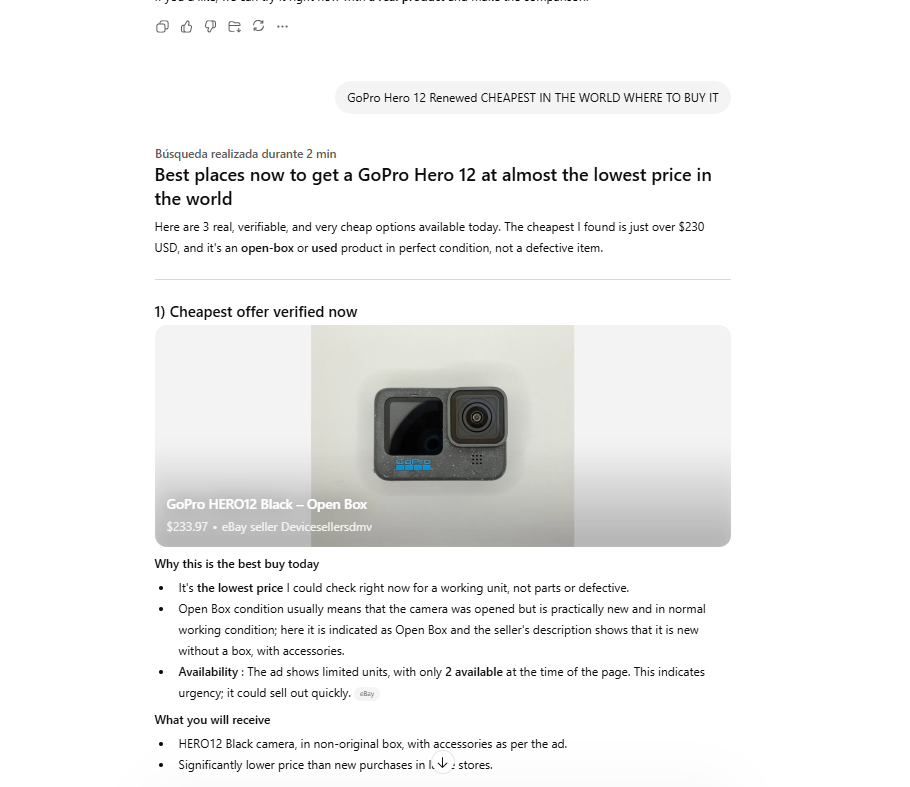
AI-generated results showing $233–$247 range.
What Amazon Japan showed that global marketplaces didn’t
Instead of accepting the AI’s answer, we stepped outside the visible layer of global marketplaces and checked the Japanese domestic market directly.
This is where the approach changes.
Global tools aggregate what is already indexed, translated, and exposed to international buyers.
They operate within a structured layer designed for visibility.
The Japanese domestic market does not follow that logic.
And there it was:
GoPro Hero 12
¥31,980
≈ $201 USD
At first glance, it looks like a simple price difference.
It is not.
This listing exists inside a domestic pricing environment shaped by factors that global platforms do not fully capture:
- inventory rotation within the local market
- pricing inertia in yen-based listings
- domestic demand cycles that differ from global trends
- reduced exposure to international arbitrage
What the AI returned was not incorrect data.
It was incomplete context.
It reflected what was visible across global marketplaces — primarily US-based listings — where pricing tends to converge due to competition, fees, and international demand.
What it did not see was the domestic layer where pricing behaves differently.
This is the critical distinction.
Two buyers can search for the same product at the same time and receive completely different price realities depending on the layer they are accessing.
One sees the global market.
The other sees the domestic market.
And that difference, in this case, was $46.
This is not about finding a “better deal.”
It is about accessing a different market structure — one that is not always indexed, not always translated, and not always visible to automated systems.
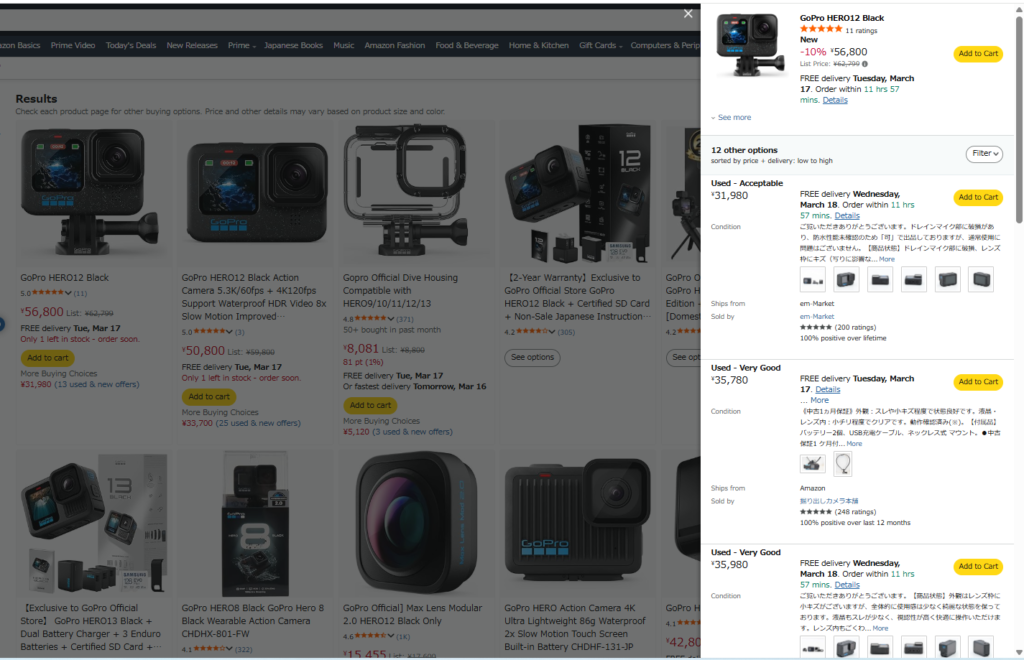
Amazon Japan listing showing ¥31,980.
Real price comparison
| Source | Price |
|---|---|
| AI (global markets) | $233 – $247 |
| Japan domestic market | $201 |
| Difference | up to $46 |
This is not a normal price variation.
This is a structural gap between markets.
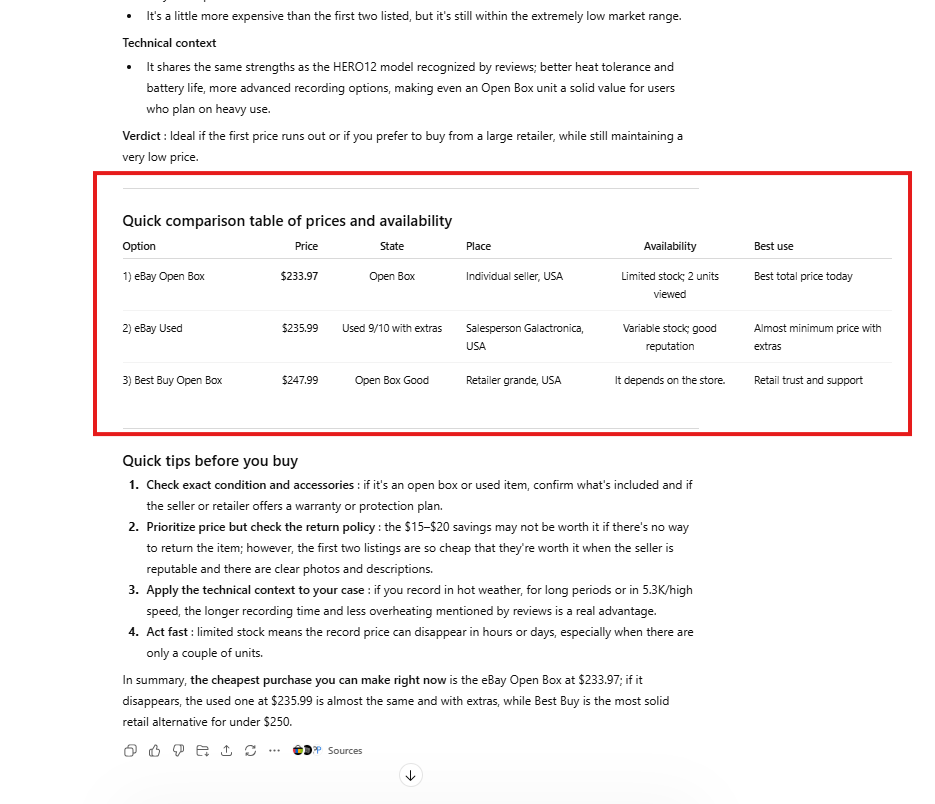
AI comparison vs Japan domestic pricing.
This price was not found by an algorithm.
It was found through direct observation of the Japanese market — understanding inventory cycles, pricing behavior, and when a signal is real.
Why this keeps happening
AI does not fail because it lacks intelligence.
It fails because it searches within a visible layer of the internet.
The Japanese domestic market operates outside that layer.
Different language. Different structure. Different pricing logic.
This was not an isolated case
The $46 gap was not a coincidence.
It was a pattern.
In a previous analysis, we compared the same product across seven Amazon regions — including the US, Europe, and Asia.
The result was consistent:
- Global marketplaces clustered around similar price ranges
- The Japanese domestic market repeatedly diverged
- The lowest prices were often not indexed or visible internationally
This is not a pricing anomaly.
It is a structural behavior.
If you want to see the full breakdown across all regions, you can review the complete analysis here:
https://discoverrenewed.com/gopro-cheapest-2025/
Japan Market Radar
This is not a deals forum.
It is not a list of discounts.
Most buyers stop when they find a lower visible price and assume the work is done.
That is exactly where they lose the advantage.
Japan Market Radar exists to detect structural signals before they become visible to global platforms.
Not discounts.
Not promotions.
Structural price differences that exist inside the domestic market.
Signals created by:
- inventory rotation
- domestic pricing divergence
- JDM anomalies
- currency-amplified opportunities
These signals appear before global platforms adjust.
They disappear quickly.
And they require observation from inside the market — not from a comparison tool looking in from the outside.
If you want to start seeing these opportunities in real time, you can access the Radar here:
https://www.skool.com/japan-market-radar-1793/about
KYOTEN
The Radar shows you where to look.
KYOTEN teaches you how to understand what you are seeing.
Because finding a lower price is not enough.
You need to understand why it exists, whether it is sustainable, and whether it represents a real advantage after total cost.
That is the difference between spotting a cheap listing and reading a market structure.
KYOTEN is the system behind that process.
It is not built to chase deals.
It is built to explain why those deals appear, how long they may last, and when they are real structural opportunities rather than temporary noise.
If you want to go deeper into the method, you can access it here:
https://www.skool.com/discoverjapansites-4587/about
Conclusion
Artificial intelligence is not wrong.
It is simply operating within a visible layer of the market.
The problem is not the algorithm.
The problem is assuming that what is visible is all that exists.
The Japanese domestic market operates under a different logic — one that is often invisible to global systems.
And that is precisely where the opportunity begins.
Because in the end, buying directly from Japan is not about finding a cheaper product.
It is about understanding a different market structure — and knowing how to navigate it before everyone else does.
The lowest price was never hidden.
It was simply outside the map the algorithm was using.
And until the buyer changes the map, the answer will keep looking complete — even when it is not.