For several months, public activity became noticeably quieter on Discover Japan Sites and Discover Renewed, as well as on Japan Digital Hub and within the communities connected to KYOTEN.
This was not the abandonment of the ecosystem.
It was a period of consolidation in which years of research into Japan, JDM products, international pricing, compatibility, import risk, regional barriers, and market behavior were transformed into a defined methodology.
That work has now produced two published editions of KYOTEN.
These are not two identical books separated only by language.
Each edition was developed to interpret a different market environment.
The Two KYOTEN Editions
English Edition
KYOTEN: Strategic Intelligence for Structural Market Asymmetry
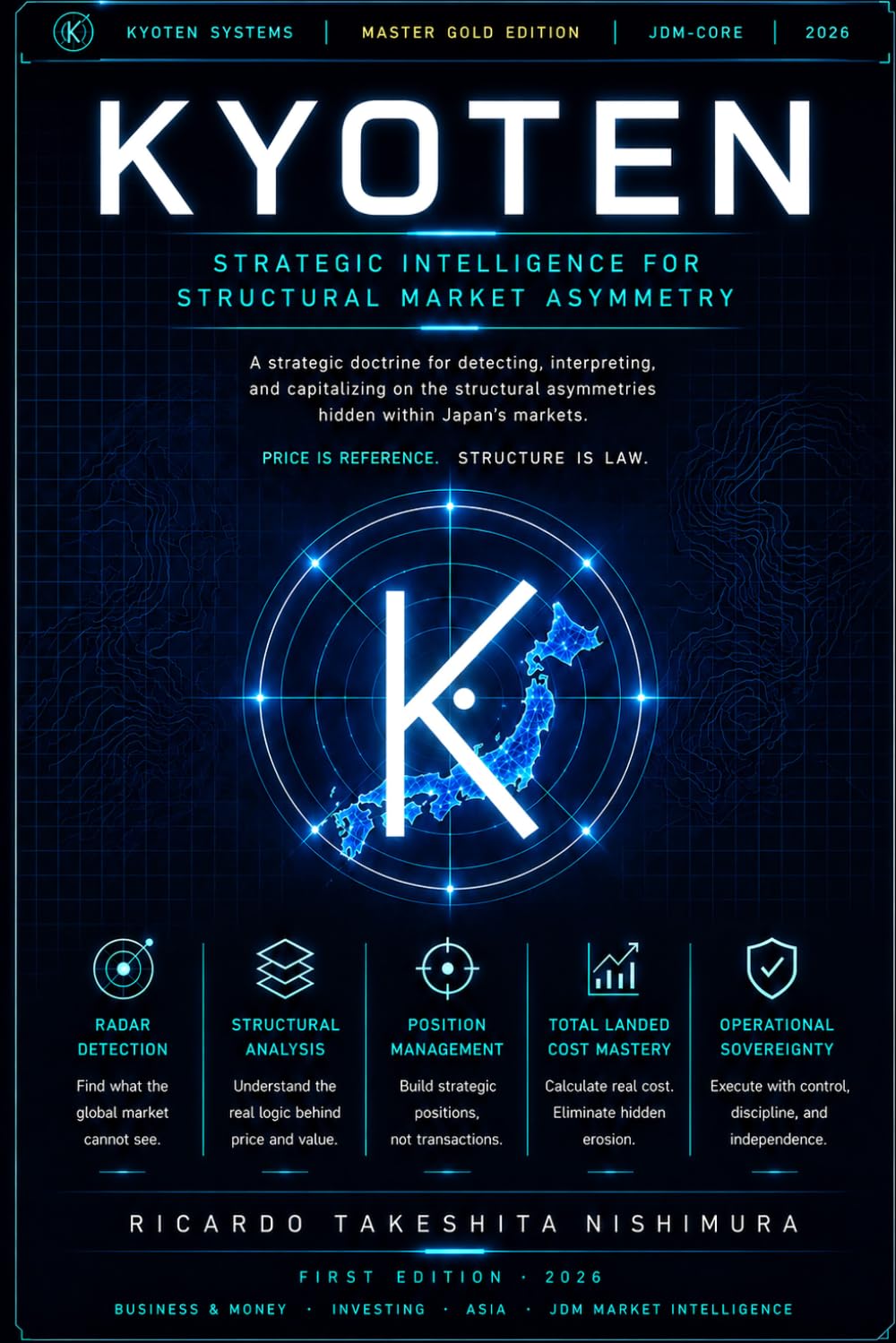
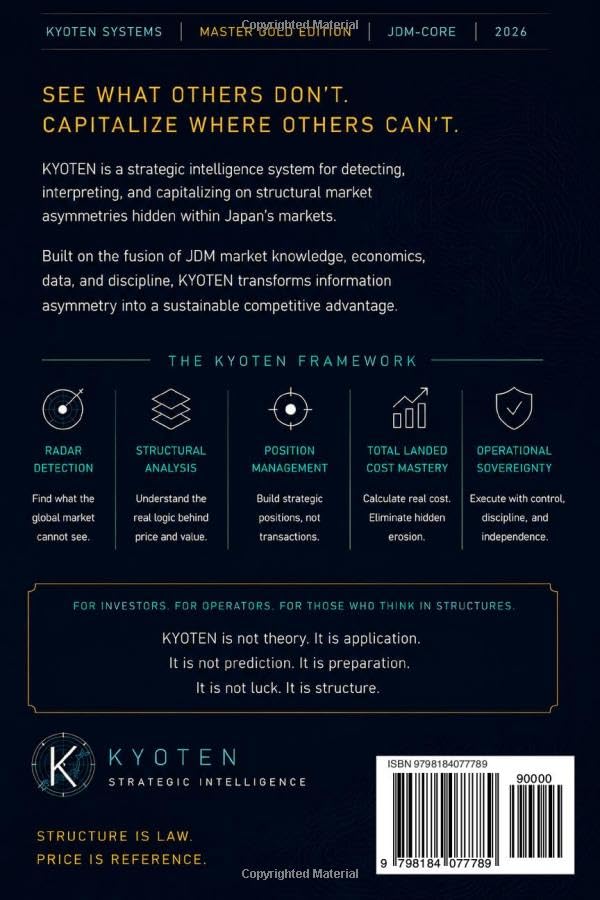
The English edition examines the global layer of structural market asymmetry and the operational distance between domestic Japanese channels and international markets.
It questions the assumption that internet access has made all markets equally visible, accessible, and understandable.
Spanish Edition
KYOTEN: Inteligencia Estratégica para la Asimetría Estructural del Mercado

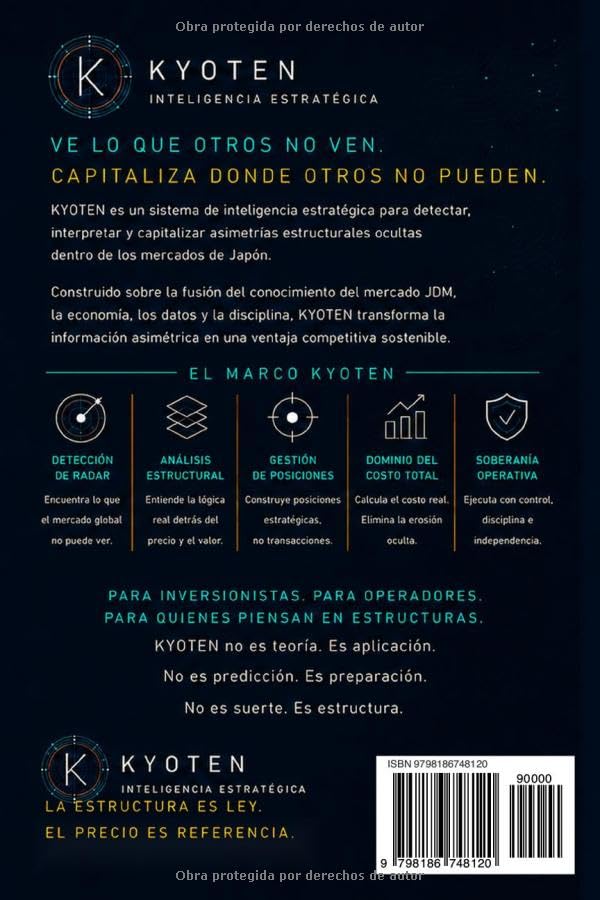
The Spanish edition was substantially expanded to address the additional regulatory, logistical, financial, and commercial risks found across Spanish-speaking markets, especially in Latin America.
It examines what happens when an apparent opportunity must survive customs, taxation, currency volatility, limited guarantees, counterfeiting risks, and unequal buyer protection.
A Book Born Inside a Wider Ecosystem
KYOTEN did not begin as an isolated publishing project.
Before the books were completed, the ecosystem already contained more than one hundred articles, guides, comparisons, and market observations related to:
- buying from Japan;
- Japanese domestic market products;
- JDM and international product differences;
- regional price gaps;
- new, used, and renewed products;
- import costs and taxes;
- compatibility;
- digital access;
- market risk;
- international purchasing barriers.
Discover Japan Sites became the main point of entry for understanding Japan and its relationship with international consumers.
Discover Renewed expanded the analysis into product condition, useful life, depreciation, warranty, and the real value of used or professionally renewed goods.
Japan Digital Hub explored software, hardware, digital restrictions, subscriptions, regional access, and compatibility.
Japan Market Radar was created to identify specific market signals.
KYOTEN Premium was reserved for a deeper and more restricted application of the methodology.
The websites became the field of observation.
The books transformed those observations into a structured doctrine.
KYOTEN Is Not About Finding the Cheapest Product
The starting question is not:
Where can this product be purchased for the lowest price?
The more important question is:
What distance exists between two markets, and what practical capacity is required to cross it?
A low price in Japan does not automatically represent a commercial opportunity.
A real decision must also consider:
- the original sales channel;
- language barriers;
- domestic payment systems;
- availability;
- international shipping;
- taxes and customs;
- exchange rates;
- technical compatibility;
- warranty;
- seller reputation;
- counterfeit risk;
- recognition of value in the destination market.
A product may appear inexpensive at the source and lose its entire advantage after logistics, regulation, and risk are added.
The opposite may also occur.
A product without a large discount may preserve a strong position because of its origin, durability, specialization, scarcity, traceability, or suitability for a specific buyer.
For that reason, KYOTEN is not only a methodology for identifying possibilities.
It is also a methodology for rejecting weak operations before they consume time, capital, and credibility.
The English Edition: The Global Layer
The English edition examines a widely accepted assumption: that the internet has unified international markets.
Digital access creates the impression that every product, price, and seller can be found from anywhere.
Operational reality remains different.
Many domestic markets still depend on:
- local-language searches;
- regional platforms;
- domestic auctions;
- local payment methods;
- national delivery addresses;
- specialized distributors;
- systems that were never designed for international buyers.
Information may be publicly available and still remain operationally inaccessible.
The global market sees one layer.
The domestic market preserves another.
The English edition studies this distance from an international perspective.
It is not a catalogue of Japanese deals. It explains why digital visibility does not necessarily create equal access, equal knowledge, or equal commercial capability.
The Spanish Edition: A Different Commercial Reality
The Spanish edition was not developed as a mechanical translation of the English book.
It was substantially expanded because Spanish-speaking markets often face additional layers of operational risk:
- currency volatility;
- customs bureaucracy;
- accumulated taxes;
- expensive logistics;
- informal sales channels;
- limited buyer protection;
- warranties that are difficult to enforce;
- counterfeit products;
- uncertain specifications;
- excessive intermediaries;
- restricted purchasing power.
In these markets, an apparent price advantage can disappear before the product reaches its destination.
A transaction may fail because of customs procedures, documentation, shipping costs, technical incompatibility, lack of replacement parts, limited warranty coverage, or weak perception of value.
The Spanish edition therefore gives greater attention to protecting the decision.
Finding a difference between Japan and another country is not enough.
That difference must survive the complete journey from the original channel to the final buyer.
Japan as a Market Laboratory
KYOTEN uses Japan as a market laboratory because its domestic economy contains a distinctive combination of conditions:
- highly specialized products;
- dense domestic distribution channels;
- JDM versions designed for local needs;
- regional manufacturers with limited global visibility;
- services built primarily for Japanese consumers;
- products that were never fully adapted or promoted internationally.
Part of Japan’s value is not hidden.
It is insufficiently translated into the commercial language of other markets.
However, the methodology does not assume that every Japanese product is automatically better or commercially viable.
A well-made product may still be:
- incompatible with the destination country;
- expensive to maintain;
- difficult to repair;
- poorly understood by the intended buyer;
- unprofitable after shipping and taxes;
- unsuitable for the actual need.
Japan is used as a laboratory for structural observation, not as an automatic guarantee of purchase.
Two Editions, One Central Conclusion
The English and Spanish editions examine different realities, but they share one central conclusion:
Technology connected the world, but it did not eliminate the distance between markets.
Important differences remain in:
- access;
- language;
- regulation;
- knowledge;
- trust;
- distribution;
- after-sales service;
- purchasing power;
- perception of value.
Those differences may create opportunities.
They may also create expensive mistakes.
The global edition analyzes the false transparency of international digital commerce.
The Spanish edition adds another defensive layer for markets where bureaucracy, volatility, fraud, and limited protection can destroy an apparently attractive operation.
Together, both editions demonstrate that a strategy cannot simply be copied from one region to another.
The market must first be interpreted.
Japan Market Radar and KYOTEN Premium
Japan Market Radar
Japan Market Radar is the free and public layer of the ecosystem.
Its role is not to publish products simply because their prices have fallen.
Each signal should help explain:
- what changed;
- why it may matter;
- who could benefit;
- which risks must be reviewed;
- when the apparent opportunity should be rejected.
KYOTEN Premium
KYOTEN Premium has a different function.
It is not intended to repeat the books or duplicate the public articles.
Its role is to support deeper application through:
- processes;
- case analysis;
- evaluation;
- development of commercial judgment;
- supervised interpretation;
- operational capacity.
The public layer identifies the signal.
The Premium layer develops the ability to interpret it.
KYOTEN Begins a New Stage
Both editions are now available through Amazon.
This launch represents more than the publication of two books.
It consolidates a methodology developed from Japan to interpret markets that appear connected but remain separated by operational, linguistic, regulatory, and cultural barriers.
The next step is to transform that methodology into signals, analyses, tools, and commercial channels capable of connecting Japanese value with real needs in international markets.