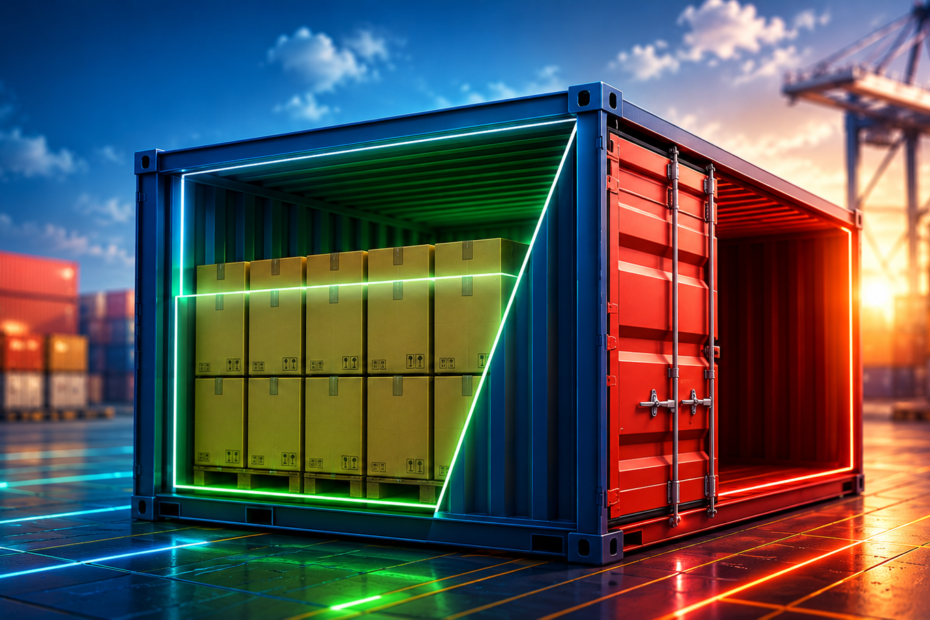
Why nominal capacity, usable capacity, and commercial capacity are not the same thing.
A freight container is sold as a standardized unit.
Its external dimensions, maximum gross mass, structural approval and equipment category can be documented. This creates the impression that two companies booking the same type of container are buying the same transport capacity.
They are not necessarily buying the same commercial result.
One company may convert the container into 480 loaded units but deliver only 430 sellable units. Another may load 440 units and deliver all 440 in commercially usable condition.
The first container looked fuller.
The second container converted more of its capacity into value.
This is Container Utilization Asymmetry: the persistent gap between the capacity sold by the transport system and the capacity an operator can safely convert into intact, accessible and commercially usable units.
One Container Can Contain Several Capacities
Nominal volume is only the outer promise.
Inside that promise, an operator must distinguish at least five different capacities:
- Nominal capacity: the volume and payload associated with the equipment.
- Accessible capacity: the space that cargo can physically reach through the door and loading process.
- Safe capacity: the cargo that can be distributed, protected and secured without violating a hard constraint.
- Operable capacity: the configuration that can actually be loaded, inspected and unloaded with the available equipment.
- Commercial capacity: the units that arrive accessible and in a condition that allows them to be sold or used.
A box can fit inside the internal dimensions and still fail at the door.
A load can remain below the stated payload and still create an unacceptable concentration of mass.
A configuration can achieve a high volume percentage and still block unloading equipment.
The gap between those five capacities is where Container Utilization Asymmetry begins.
A Full Container Can Deliver Less
The conventional percentage of occupied volume measures physical occupation. It does not measure commercial conversion.
KYOTEN therefore introduces a simple public diagnostic:
Commercial Conversion Yield
Consider the following synthetic KYOTEN technical illustration. It is not presented as a reported company case. Its purpose is to isolate the mechanism.
Configuration A — Maximum Visual Occupation
- Container: 40 ft High Cube Dry
- Volume occupied: 92.4%
- Units loaded: 480
- Units rejected after arrival: 50
- Commercially usable units: 430
- Unloading time: 6.5 hours
[
Configuration B — Controlled Configuration
- Container: 40 ft High Cube Dry
- Volume occupied: 78.1%
- Units loaded: 440
- Units rejected under the illustration’s assumptions: 0
- Commercially usable units: 440
- Unloading time: 0.8 hours
Configuration A loads 40 additional units, but Configuration B delivers 10 additional sellable units.
If both containers had the same freight cost and all other configuration expenses were temporarily excluded, the comparison would be:
Under these limited assumptions, Configuration A pays approximately 2.3% more freight per sellable unit than Configuration B.
What the Percentages Hide
The example does not prove that lower utilization is always better.
It proves something more precise:
A higher filling percentage is not sufficient evidence of higher useful capacity.
Configuration B could still require additional costs for:
- slip sheets;
- push-pull equipment;
- dunnage;
- packaging redesign;
- additional planning;
- specialized labor.
Those costs must be measured before declaring B economically superior.
The correct conclusion is not “load less.”
The correct conclusion is:
Measure what the occupied space produces and what the final units cost.
A commercial decision should not compare only loaded units. It should compare usable units, damage, handling, protection and the operational requirements created by the configuration.
Empty Space Is Not One Thing
A visually empty area can perform several different functions.
KYOTEN separates the interior volume using a provisional diagnostic model:
Where:
- (V_N): internal volume considered;
- (V_C): volume occupied by commercial cargo;
- (V_P): protective space;
- (V_O): operational space;
- (V_I): unavoidable geometric space;
- (V_E): avoidable space caused by poor configuration.
This is a KYOTEN space-allocation model, not an ISO, IMO or carrier formula.
Protective Space
This may be required for:
- dunnage;
- securing;
- packaging deformation tolerance;
- air circulation when specified;
- protection against contact;
- safe separation.
Operational Space
This enables:
- forklift access;
- push-pull operations;
- inspection;
- manual handling;
- unloading in the required sequence.
Unavoidable Space
This can result from:
- irregular product shapes;
- dimensional mismatch;
- non-stackable units;
- door geometry;
- equipment structures;
- incompatible orientations.
Avoidable Space
This is the real target for improvement.
It can arise from:
- poor load planning;
- packaging dimensions that do not work together;
- unnecessary pallet volume;
- incorrect orientation;
- uncoordinated SKU combinations;
- failure to verify the assigned equipment.
The purpose of the model is not to celebrate empty space. It is to distinguish functional space from avoidable loss.
The First Binding Constraint
Container utilization should not be treated as a race toward 100%.
It is a search for the first constraint that makes another unit unsafe, inaccessible or commercially destructive.
A cargo can reach:
- cube-out: volume is exhausted first;
- weight-out: admissible mass is exhausted first;
- door-out: the loading geometry fails at the opening;
- floor-out: support or concentration becomes unacceptable;
- handling-out: the cargo fits but cannot be manipulated correctly;
- climate-out: the configuration interferes with required environmental control;
- access-out: the final units cannot be removed in the required sequence.
The dominant constraint can change after a packaging improvement.
A smaller box may recover volume, but the additional units can move the operation from cube-out to weight-out. Removing pallets may increase available cube, but it can also create new requirements for loading and unloading equipment.
This is why optimization cannot be judged by a single percentage.
The Same Equipment Name Does Not Guarantee the Same Envelope
A booking label such as “40 ft High Cube” does not tell the operator everything required to design the load.
Actual equipment can vary in:
- tare;
- payload;
- internal height;
- door opening;
- floor characteristics;
- securing points;
- construction series;
- manufacturer;
- operator restrictions.
Hapag-Lloyd warns that published container specifications serve as examples and that equipment can vary according to its manufacturer. Its specifications therefore should not replace verification of the assigned unit.
The current dimensional reference is ISO 668:2020, but an ISO classification does not eliminate operational variation between actual units. The specific container, plate and carrier conditions still matter.
A calculation based on one illustrative 40HC might use:
If the assigned unit shows:
- Maximum Gross Mass: 30,480 kg
- Actual or verified tare: approximately 3,900 kg
then:
That result belongs to that equipment example. It is not the universal payload of every 40HC.
The same logic applies to volume. A High Cube provides more nominal cube, but that extra volume creates little value when a dense cargo reaches its executable mass limit first.
Weight Is Verified, but Configuration Still Matters
SOLAS requires the Verified Gross Mass of a packed container before it can be loaded onto a ship covered by the regulation.
VGM can be obtained by:
- weighing the packed container; or
- adding the mass of cargo, packages, pallets, dunnage and securing materials to the container tare through a method approved by the competent authority.
This verification is essential, but it answers one question:
What is the verified gross mass of the packed container?
It does not by itself prove:
- correct weight distribution;
- acceptable concentrated loads;
- internal securing;
- safe center of gravity;
- packaging resistance;
- unloading access;
- commercial conversion.
The International Convention for Safe Containers addresses the structural approval and safety of the container. The CTU Code provides extensive guidance for packing and securing cargo transport units. Dangerous goods may also be subject to the mandatory IMDG Code.
These instruments establish boundaries.
They do not calculate the best commercial configuration for a specific operator.
That decision remains inside the asymmetry.
Tekizai Tekisho — The Appropriate Material in the Appropriate Place
Japanese practice offers a deeper way to understand this problem.
適材適所 — Tekizai Tekisho can be translated literally as:
The appropriate material in the appropriate place.
The expression is now frequently used for placing the right person in the right role. Its material meaning, however, connects naturally with Japanese carpentry.
Wood is not treated as completely uniform.
Different pieces can possess different:
- grain;
- strength;
- flexibility;
- resistance;
- orientation;
- appearance;
- response to moisture.
The carpenter must first read those properties and then decide where each piece can perform its proper function.
The Takenaka Carpentry Tools Museum describes how Japanese craftspeople read the individual character of wood and use it in the appropriate place to bring out its qualities.
This principle does not ask the carpenter to force every piece into any available opening.
It asks the carpenter to understand before assigning.
Container utilization requires the same quality of observation.
The operator must read:
- the cargo;
- the packaging;
- the equipment;
- the protection;
- the handling system;
- the destination operation.
A 40HC is not automatically the appropriate container because it offers more volume.
A pallet is not automatically waste because it occupies space.
A smaller package is not automatically superior because more units can be loaded.
An empty margin is not automatically inefficient when it protects, stabilizes or enables access.
Tekizai Tekisho changes the question from:
How much can we force into the container?
to:
Which configuration allows every element to perform the correct function?
In KYOTEN, the philosophy becomes a method: read the properties, assign the place, protect the whole, and measure the commercial result.
Kumiki — The Structure Created Between the Parts
Tekizai Tekisho provides the main philosophy.
Kumiki provides its structural expression.
In Japanese woodworking, Kumiki refers to the precise assembly of pieces whose geometry allows them to form a stable three-dimensional structure. The strength of the result does not belong to one isolated piece. It emerges from the relationships between the pieces.
The container analogy must be used carefully.
Cargo should not be treated literally like an interlocking wooden structure, and geometric contact does not replace securing, dunnage, airflow requirements or engineering.
The useful insight is relational:
- packaging affects stacking;
- stacking affects compression;
- compression affects damage;
- dunnage affects movement;
- movement affects stability;
- orientation affects access;
- access affects unloading;
- unloading affects commercial availability.
A configuration cannot be optimized by improving one element while ignoring the rest.
The Last Unit Is a Decision, Not a Victory
The final unit that fits inside the remaining space can be the most deceptive unit in the load.
It may contribute one additional sale.
It may also:
- remove a protective margin;
- obstruct access;
- require new dunnage;
- increase compression;
- shift the center of gravity;
- extend unloading;
- expose the entire load to additional damage.
The correct question is:
What changes in the whole configuration when unit N+1 is added?
At a minimum:
> Incremental damage, handling and protection cost
This is only an initial public expression. A professional decision must convert each component into compatible units, test all hard constraints and evaluate the effect on the complete load.
The fact that one more unit fits does not prove that one more unit should be loaded.
From Filled Space to Converted Value
Container Utilization Asymmetry is not a defense of unused capacity.
It is a system for distinguishing:
- unused capacity;
- unusable capacity;
- protective capacity;
- operational capacity;
- falsely optimized capacity;
- commercially converted capacity.
The opportunity is not created by a universal filling percentage.
It appears when one operator can understand the relationship between cargo, packaging, equipment and operation more accurately than another.
Both companies may purchase the same nominal container.
One purchases space.
The other designs a usable capacity system.
That difference can affect:
- damage;
- rejection;
- labor;
- unloading;
- cost per usable unit;
- reliability;
- commercial continuity.
Tekizai Tekisho explains the principle: the appropriate material must occupy the appropriate place.
Kumiki explains the structure: value emerges from the relationship between the parts.
KYOTEN adds the measurement:
A container is optimized only when its configuration converts nominal capacity into safe, accessible and commercially usable value.
Technical Basis
- IMO — International Convention for Safe Containers
- IMO — Verification of the Gross Mass
- IMO/ILO/UNECE — CTU Code
- IMO — IMDG Code
- ISO 668:2020 — Classification, Dimensions and Ratings
- ISO 1496-1:2013/Amd 2:2024
- Hapag-Lloyd — Container Specifications
- Takenaka Carpentry Tools Museum
- Japan Up Close — Traditional Japanese Kumiki