DISCOVER JAPAN SITES AI
Ask in your language. Get answers with context, not just keywords.
Welcome. What would you like to know?
The structural reason why three companies operating in the same ecosystem capture 70%, 54%, and 20% gross margin respectively — and why effort alone cannot explain the difference.
Consider the following illustrative scenario, based on structural patterns repeatedly observed in international trade.
Three companies operate in the same industry. They serve the same end market. They contribute to the same final product. They employ world-class engineers. They invest billions in capital equipment. They operate under intense competitive pressure.
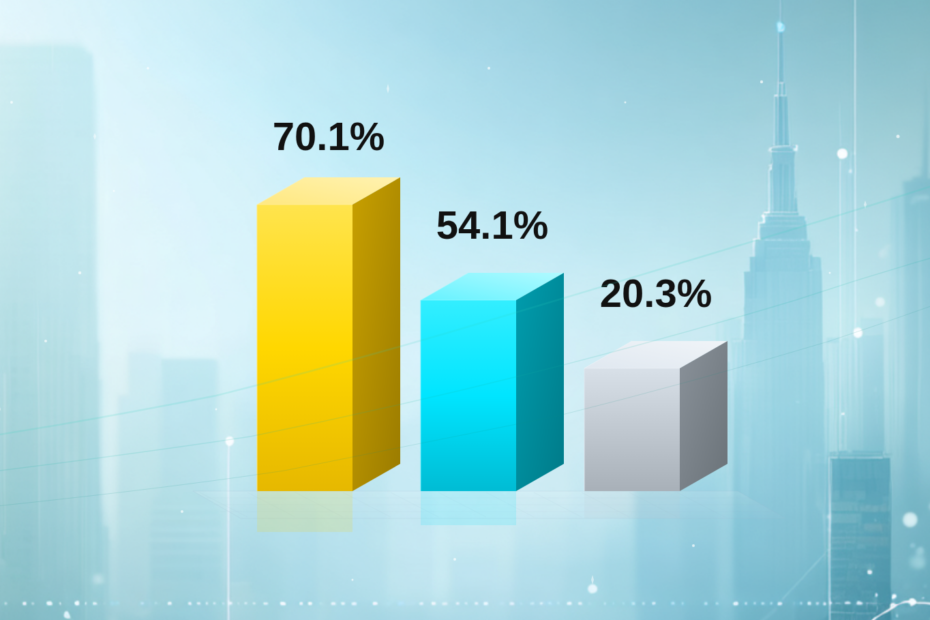
After a decade of operations, Company A captures 70.1% gross margin. Company B captures 54.1%. Company C captures 20.3%.
A fifty-percentage-point spread — inside the same ecosystem.
The difference is not effort. Company C works harder per unit of revenue than Company A. The difference is not talent. All three employ exceptional engineers. The difference is not capital. Company C invests more per dollar of output.
The difference is where each company sits within the value chain.
Company A controls design and intellectual property — a node that extremely difficult to replicate within the current technological paradigm. without decades of accumulated knowledge. Company B controls advanced manufacturing at the technological frontier — difficult to replicate but not impossible. Company C performs commodity manufacturing — a node where any competitor with capital can enter and compress margins for everyone.
The structure of the chain itself determines who captures value. The node you occupy sets your ceiling before you begin to execute.
This is not merely a metaphor. It is a structural pattern that has been repeatedly observed across multiple industries and global value chains.
KYOTEN calls it Strategic Position Asymmetry.
The Smile Curve Reflects a Widely Observed Structural Pattern
The Smile Curve has become one of the best-known frameworks for understanding value creation within global value chains. Originally proposed by Stan Shih during the evolution of Acer, the concept illustrates how activities at the upstream end—such as research, design, and intellectual property—and at the downstream end—such as branding, platforms, and customer relationships—tend to capture more value than standardized manufacturing activities in the middle of the chain.
Over the past two decades, research on global value chains by organizations such as IDE-JETRO and scholars including Gary Gereffi, Ram Mudambi, and others has repeatedly examined how different positions within production networks influence value capture. Although methodologies differ, the recurring observation is consistent: structural position matters.
The Smile Curve should therefore be understood not as a law that guarantees outcomes, but as a framework that helps explain why companies performing different functions within the same ecosystem often experience very different economic return
The three companies described above are not fictional. They are real. They reported these gross margins in Q2 2023:
NVIDIA (design and IP): 70.1%.
TSMC (advanced manufacturing): 54.1%.
SMIC (commodity manufacturing): 20.3%.
Same silicon. Same end customer ecosystem. Same decade. The spread is entirely structural.
The midstream operator works harder. The midstream operator invests more capital per unit of revenue. The midstream operator faces more competitive pressure. And the midstream operator captures less value.
This is the structural reality that Strategic Position Asymmetry describes.
Position Creates Leverage Before Execution Creates Performance
The conventional wisdom in business education teaches that competitive advantage comes from superior execution. Work harder. Optimize processes. Reduce costs. Differentiate your product. Serve customers better.
None of that is wrong. But all of it is incomplete.
What conventional wisdom misses is that execution operates within structural constraints set by position. A company in a replaceable node can optimize indefinitely and still face margin compression — because its position allows adjacent participants to extract value through bargaining power, substitution threats, and commoditization pressure.
A company in a structurally advantaged node can execute moderately and still capture disproportionate value — because its position creates switching costs, information asymmetries, and dependency relationships that protect margins independent of daily operational decisions.
Four distinct academic traditions — Porter’s activity configuration, Gereffi’s governance theory, Mudambi’s functional positioning, and Shih’s ecosystem embeddedness — all converge on one principle:
Knowledge-intensive, difficult-to-replicate positions yield superior returns regardless of who occupies them.
Structural position creates conditions that can amplify—or constrain—the effectiveness of execution. The operator inherits structural advantage by occupying it.
Kurai (位): The Japanese Concept That Explains Positional Thinking
In the Japanese strategic tradition, there exists a concept that captures this principle with extraordinary precision.
Kurai (位) means rank, position, and structural leverage.
In Go — the strategic board game that has shaped Japanese military, business, and political thinking for centuries — kurai refers to positional influence and dominance. The great master Honinbo Sanetsu documented this principle in the early 17th century: the player who establishes superior positional influence before tactical engagement captures disproportionate territory from every subsequent interaction.
In kenjutsu (sword arts), kurai describes the advantage gained from occupying a superior position before the engagement begins. The outcome is substantially determined by where you stand — not by how fast you swing.
The concept extends further. Kigurai (気位) — combining spirit (気) and rank (位) — describes the commanding presence that emerges naturally from occupying a position of structural superiority. It is not performed. It is not projected. It radiates from the position itself.
This is precisely how structural position operates in global value chains. ASML does not need to market aggressively. ARM does not need to manufacture anything. Visa does not need to hold deposits. Their positions generate leverage that precedes and exceeds any tactical execution.
Kurai is not metaphor. It is mechanism.
STRUCTURAL POSITION vs. COMPETITIVE ADVANTAGE
Why effort inside a weak node cannot overcome the structural ceiling
TRADITIONAL COMPETITIVE ADVANTAGES
✗ Better product quality
✗ Lower price
✗ Better marketing
✗ More capital invested
✗ Faster execution
Can be copied. Can be outspent. Has a ceiling determined by the node itself.
STRUCTURAL POSITION ADVANTAGES
✓ Temporal barriers to replication (20+ years)
✓ Ecosystem lock-in dependencies
✓ Exclusive partnership access
✓ Self-reinforcing data feedback loops
✓ Switching cost penalties for customers
Cannot be copied within the current technological regime. The position itself generates the leverage.
Kurai (位) — The outcome is determined by where you stand before the engagement begins.
What ASML Reveals About the Architecture of Structural Monopoly
If you want to understand Strategic Position Asymmetry at its extreme, study one company: ASML.
ASML consistently ranks among Europe’s most valuable technology companies and maintains one of the strongest profitability profiles in the semiconductor equipment industry.
But here is what matters for KYOTEN doctrine: ASML’s dominance is not primarily a product quality story. It is a structural position story.
The company’s position rests on interlocking mechanisms that no competitor can replicate regardless of capital availability:
Temporal barriers. EUV development began in 1997. First production machines shipped in the late 2010s. Twenty years of accumulated knowledge cannot be compressed by throwing money at the problem.
Ecosystem lock-in. EUV machines consist of over 100,000 components. ASML produces only 15% internally. Its supplier network exceeds 5,150 companies — each one calibrated to ASML’s specifications over decades.
Exclusive partnerships. Carl Zeiss has exclusively developed EUV lens modules for ASML for over thirty years, with processing accuracy smaller than a single silicon atom. ASML owns 24.9% of Carl Zeiss SMT.
Customer captivity. Mixing lithography brands introduces calibration differences causing pattern shifts and reduced yield. The yield loss far exceeds any procurement savings. Single-supplier dependency is economically rational for every customer.
Self-reinforcing feedback. Every machine ASML installs generates production data that improves the next generation. China’s attempt to replicate EUV in a “Manhattan Project” style effort failed — not due to inferior engineering, but because the true barrier lies in the ecosystem and data feedback loops built over three decades.
This is Kurai made industrial. The position is so structurally superior that tactical responses by competitors become irrelevant before they begin.
KYOTEN Finding
Strategic Position Asymmetry is not a theory about large corporations. It is a structural principle that operates at every scale.
The operator who controls a knowledge-intensive bottleneck in any value chain — whether that chain involves semiconductor equipment or artisanal food distribution — captures value that operators in replaceable nodes cannot access regardless of effort.
The available evidence consistently points in the same direction:
Research on global value chains and the Smile Curve consistently shows that firms occupying knowledge-intensive or customer-controlling positions tend to capture a disproportionate share of value compared with firms performing standardized manufacturing activities. The semiconductor industry demonstrates a 50-percentage-point gross margin spread between design positions and commodity manufacturing positions. ASML demonstrates that structural position can generate 48.7% ROE and €527 billion in market capitalization through mechanisms that no competitor can replicate.
The practical implication for international trade operators is direct: before optimizing execution within your current position, evaluate whether your position itself allows structural value capture — or whether you are working harder inside a node that the system has already designated for margin compression.
The question is not “How do I sell better?”
The question is “Am I positioned where structural forces work in my favor — or against me?”
Kurai teaches that the outcome is determined before the engagement begins.
Where you stand matters more than how hard you fight.
What Comes Next
This week’s Japan Market Radar tracks companies that are actively repositioning within their value chains — moving from replaceable nodes toward structural bottlenecks. The signals appear in public data years before the financial results change. Operators who recognize these patterns gain positioning intelligence that competitors using standard analysis cannot access.
Technical References
Li, L., Meng, B., Lei, L., Ye, J., & Guo, J. (2026). The Impact of Industrial Value Chain Characteristics on Firms’ Financial Performance: Insights from the US Stock Market. IDE-JETRO Discussion Paper No. 928.
Mudambi, R. (2008). “Location, control and innovation in knowledge-intensive industries.” Journal of Economic Geography.
Gereffi, G., Humphrey, J. & Sturgeon, T. (2005). “The governance of global value chains.” Review of International Political Economy.
Porter, M. (1985). Competitive Advantage: Creating and Sustaining Superior Performance.
Shih, W. (2020). “The Challenge of Rebuilding U.S. Domestic Supply Chains.” Harvard Business School.
TrendForce (2024). “ASML EUV Dominance & China’s Semiconductor Equipment Push.”
Bennett, A. (2024). “Budo Beat 20: Poise Under Pressure.” Kansai University.
KYOTEN Knowledge Base
This article connects to the KYOTEN doctrine of structural asymmetry recognition. Strategic Position Asymmetry represents the culmination of the intelligence sequence: after learning where NOT to compete (Competitive Density), WHEN to enter (Market Timing), and HOW to detect signals (Information Asymmetry), the operator must answer the final structural question — WHERE to position within the system so that structural forces generate cumulative advantages.
The methodology for measuring positional advantage — the Strategic Position Index (SPI) — is available exclusively in the KYOTEN Premium Classroom.