

DISCOVER JAPAN SITES AI
Ask in your language. Get answers with context, not just keywords.
Welcome. What would you like to know?
Two shoppers use the same platform. They see the same product, price, origin and destination—yet their international shopping carts can have different effective costs. The advantage need not be a secret coupon, a better supplier or a smarter price tracker. It may come from the way the order itself is structured.
Imagine finding a useful item for a low price, only to discover that shipping costs several times more than the product. The obvious response is to close the page. But an experienced shopper may ask a better question: what happens to the whole order if I change the quantity—or add something else I actually need?
This is where we apply KYOTEN: not as a new shopping doctrine, but as a practical combination of its existing principles of observation, structural asymmetry, constraints and verification. We tested a real product in Amazon Japan at four quantities, then compared the visible listings in the US market. Here is what the evidence shows, what it does not show, and how any online shopper can use the same reasoning.
Scope: international shopping. This masterclass applies KYOTEN–ONE, KYOTEN–MIX and KYOTEN–ADUANA specifically to cross-border online purchasing, including international shipping, import charges, product quantities and the destination. They are not formulas designed to replace coupons or price comparison in local retail. KYOTEN as a doctrine is universal; international shopping is one practical application.
The twelve myths of international shopping savings
Coupons and trackers can find excellent offers, especially for local purchases. The myth is the assumption that the cheapest individual listing automatically gives the lowest total international purchasing cost. Here are twelve assumptions to test:
| Assumption | What the international cart can reveal |
|---|---|
| 1. The lowest listed item price guarantees the greatest saving. | The final cross-border cost may include freight and import charges that change the ranking. |
| 2. A price tracker solves the complete purchase. | Tools such as Keepa can reveal genuine opportunities, but do not optimize shipping and the full international basket by themselves. |
| 3. A coupon means the order is already optimized. | An individual discount can be valuable without solving the complete international-order cost. |
| 4. A 40% markdown must be the winning option. | The advertised discount is not the same measure as the incremental cost of a needed product in a combined cross-border cart. |
| 5. Two buyers seeing the same product price will incur the same effective cost. | The same origin, destination and store can produce different per-item economics when the basket structure differs. |
| 6. An expensive single-item shipment makes every purchase of that item uneconomic. | The marginal cost of adding a needed item to an existing international order can differ substantially. |
| 7. Repeating the same product is the only way to distribute freight. | A mixed cart of goods truly needed may be more sensible than excess duplicate stock. |
| 8. The lowest average cost per unit is always the best purchase. | Buying excess inventory increases cash outlay, storage costs and possible waste. |
| 9. The listed product price is the full acquisition cost. | International freight and import costs are material variables of the decision. |
| 10. Routine consumption purchases need no strategic review. | A shopping list of recurring needs can reveal combinations that an isolated product search misses. |
| 11. The cheapest individual items always produce the cheapest complete basket. | Shared logistics and basket interactions can make that conclusion false. |
| 12. Once a basket looks favorable it will always be favorable. | Seller rules, quantities, fees and transport conditions can change, so the final checkout remains decisive. |
The core KYOTEN question is not “Where is this item cheapest?” but “How can I obtain the goods I genuinely need, in sensible quantities, at the lowest verifiable complete international cost?”
1. Same product, two markets: why these products?
Our products were selected deliberately, not at random. First, we chose Naturie Hatomugi Skin Conditioning Gel, 180 g, a widely recognized everyday skincare item with a standard, easy-to-identify size and separate Amazon listings in Japan and the United States. Its 180 g jar is used as a multipurpose moisturizer, so a shopper can understand the product without specialized technical knowledge.
Its standing is documented beyond an advertisement: Naturie’s manufacturer reports that the gel ranked No. 1 by unit sales for eight consecutive years in its defined Japanese gel-type moisturizing-cream market (Intage SRI+, February 2017–January 2025). That is a specific Japanese market claim, not an invented global ranking. See the manufacturer’s release and market definition.
We selected it because it is recognizable, affordable, used repeatedly and offered in two different markets. Those qualities make it an informative example of why the price on a product page is not the same as the total cost of receiving it. The same descriptions and 180 g size appear in our two Amazon listings, with different currencies, sellers and advertised discounts. Both are evaluated with Los Angeles, California as the destination.
Currency reference for international readers. All original screenshots and calculations use Japanese yen. We add approximate US dollar equivalents for scale, using US$1 = ¥159.86, the Bank of Japan’s central USD/JPY rate for November 13, 2026, the last business day before the November 15 test. Source: Bank of Japan, daily foreign exchange rates. These are reference conversions only, not actual card charges or verified exchange rates used by Amazon. Rounding may affect cents.
Image tip: Every checkout screenshot below is clickable. Click or tap an image to open the full-size original and check the totals yourself.
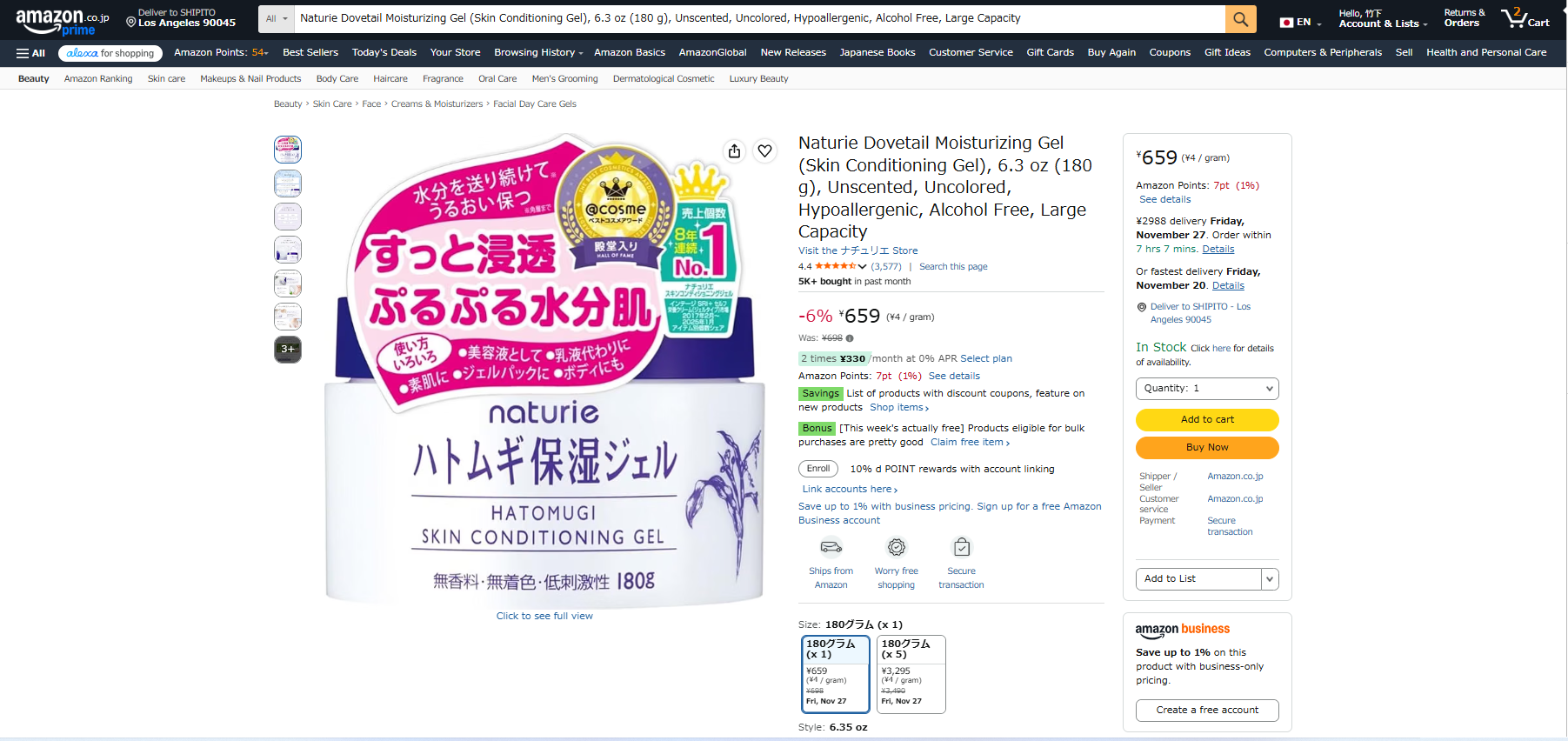
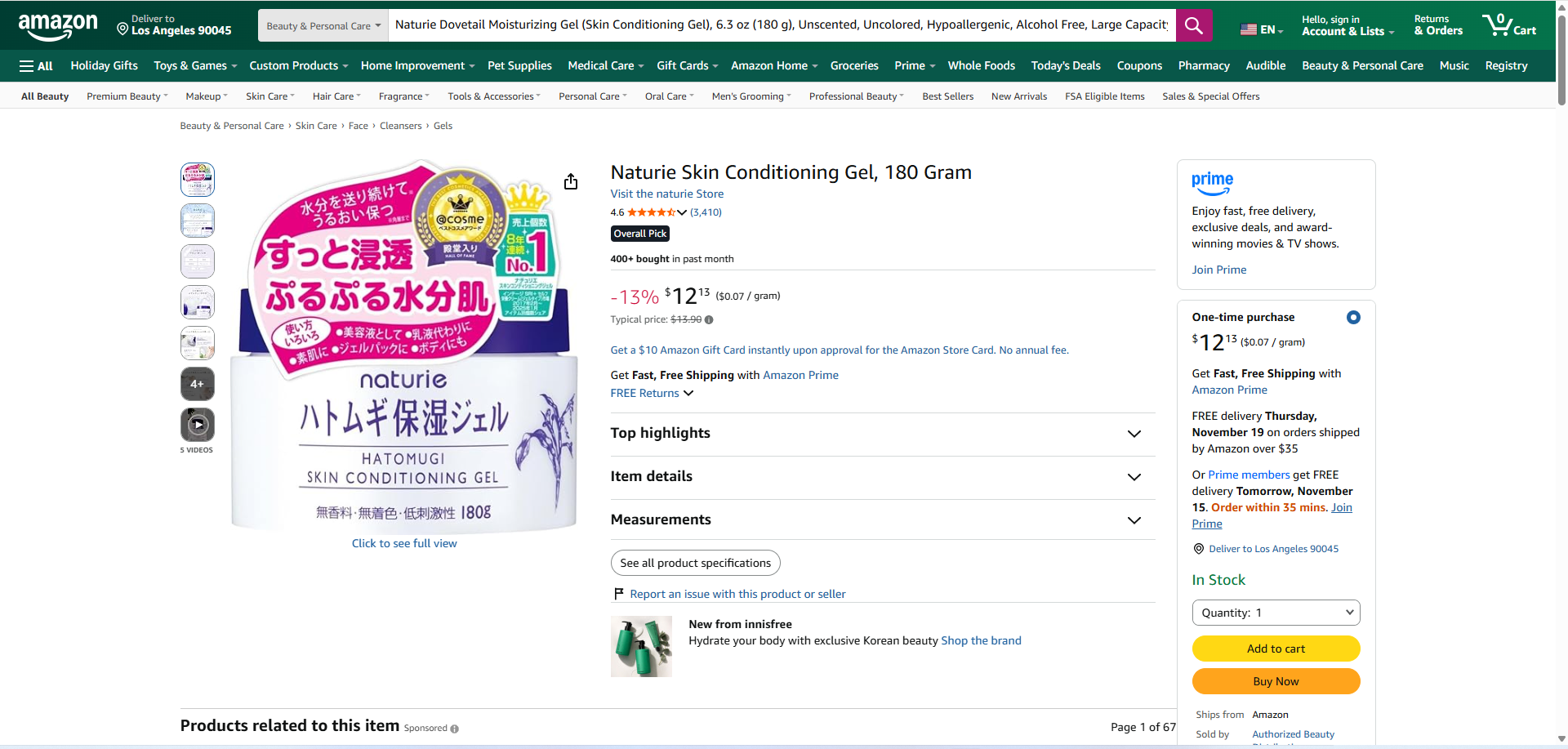
A higher discount percentage does not prove a lower final cost. The Japanese checkout also shows ¥660 per unit, one yen higher than its ¥659 product-page listing. We retain the checkout numbers for all order calculations rather than quietly replacing them with the listing price.
Product pages show matching descriptions and 180 g size, but complete ASIN/variant equivalence has not been proven from these screenshots alone. US sales tax and any US checkout conditions are not verified in this study.
Can you buy every Japanese domestic-market product this way?
No. Amazon.co.jp sells a much larger domestic catalog than the portion available for international delivery. Not every Japan Domestic Market (JDM) item can be shipped abroad. Eligibility changes by product, destination, seller and export or transport restrictions. Amazon’s FBA International Export program explains that eligible products can be delivered to international addresses, but sellers can exclude products or countries and some items are restricted.
For a buyer who does not want to arrange separate purchasing and international freight services, an eligible AmazonGlobal order can be a practical option: Amazon shows the international delivery option and estimated import charges during checkout and handles the applicable shipment to the chosen overseas address. This can simplify the process; it does not make all Japanese products available.
Important detail about our test: the Los Angeles delivery address on the screenshots belongs to Shipito, a parcel-forwarding service. The amounts we present are the AmazonGlobal checkout totals to that Los Angeles address. They are not evidence of final delivery to a private home elsewhere, nor do they include any possible onward Shipito forwarding costs. A buyer seeking doorstep delivery should enter their own eligible home address and verify that the exact item can be shipped there.
2. The real test: 3, 6, 12 and 20 units
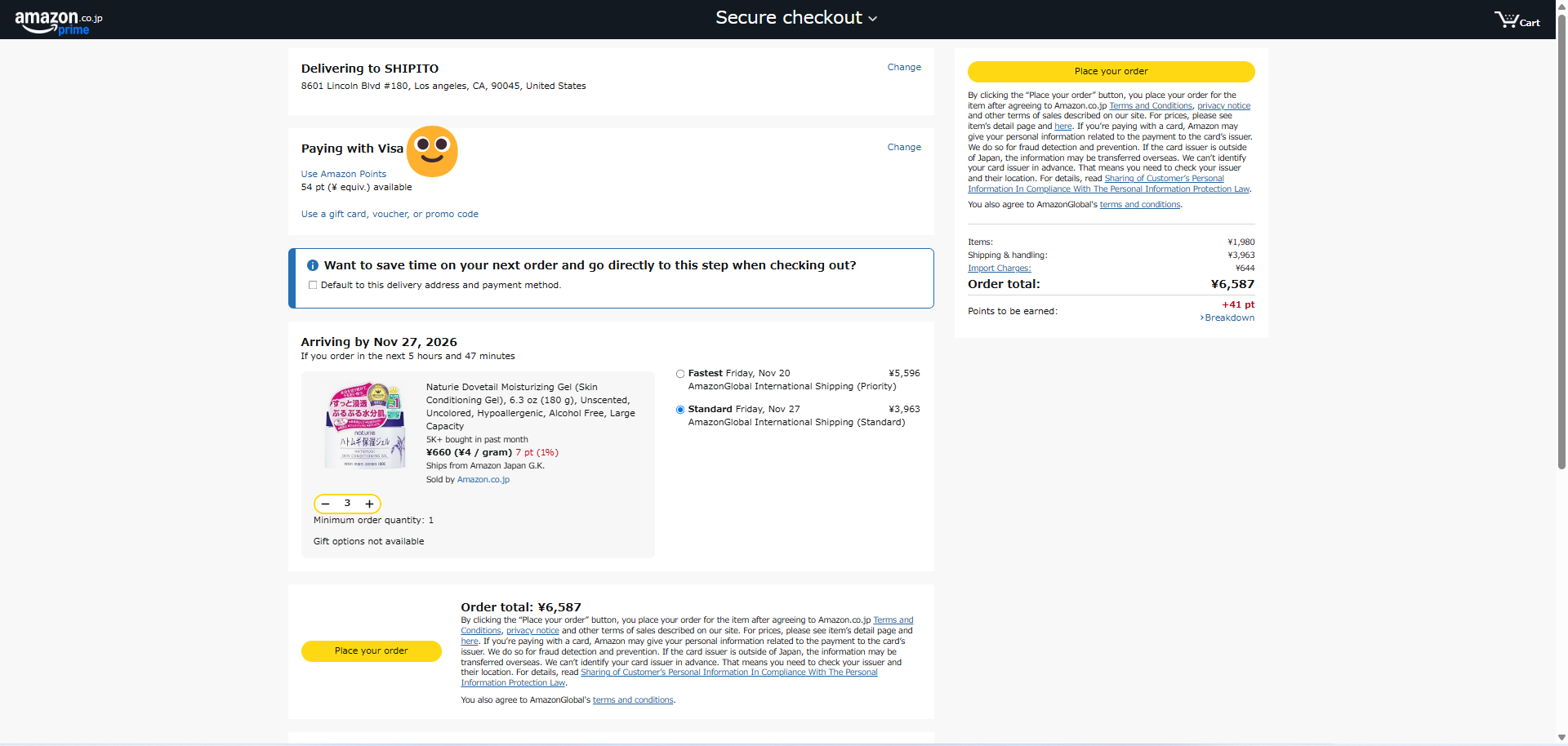
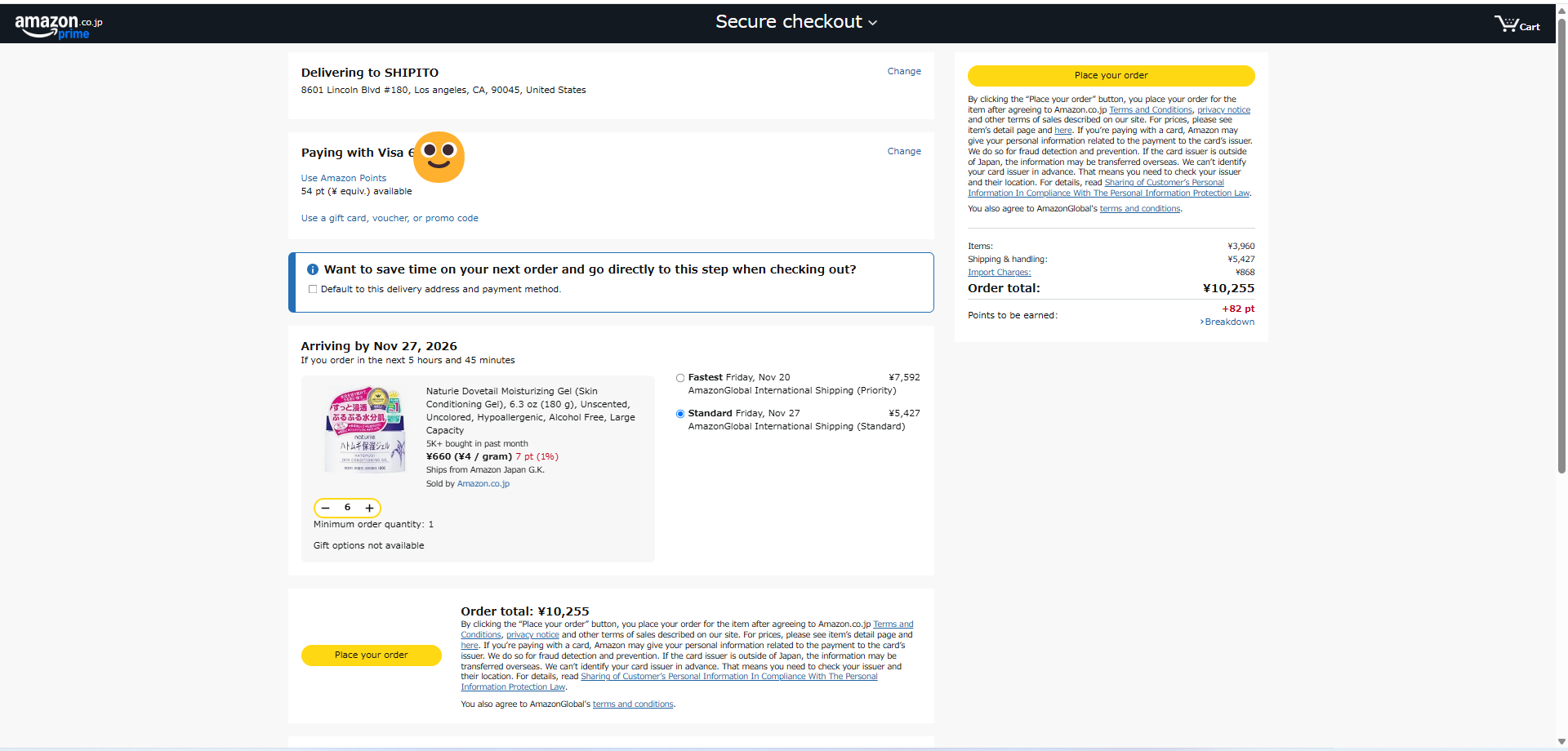
We then simulated four Amazon Japan checkouts with the same Los Angeles delivery destination, standard international shipping, and the same product. No purchase was placed. The next four images show the final cost components Amazon displayed for each order.
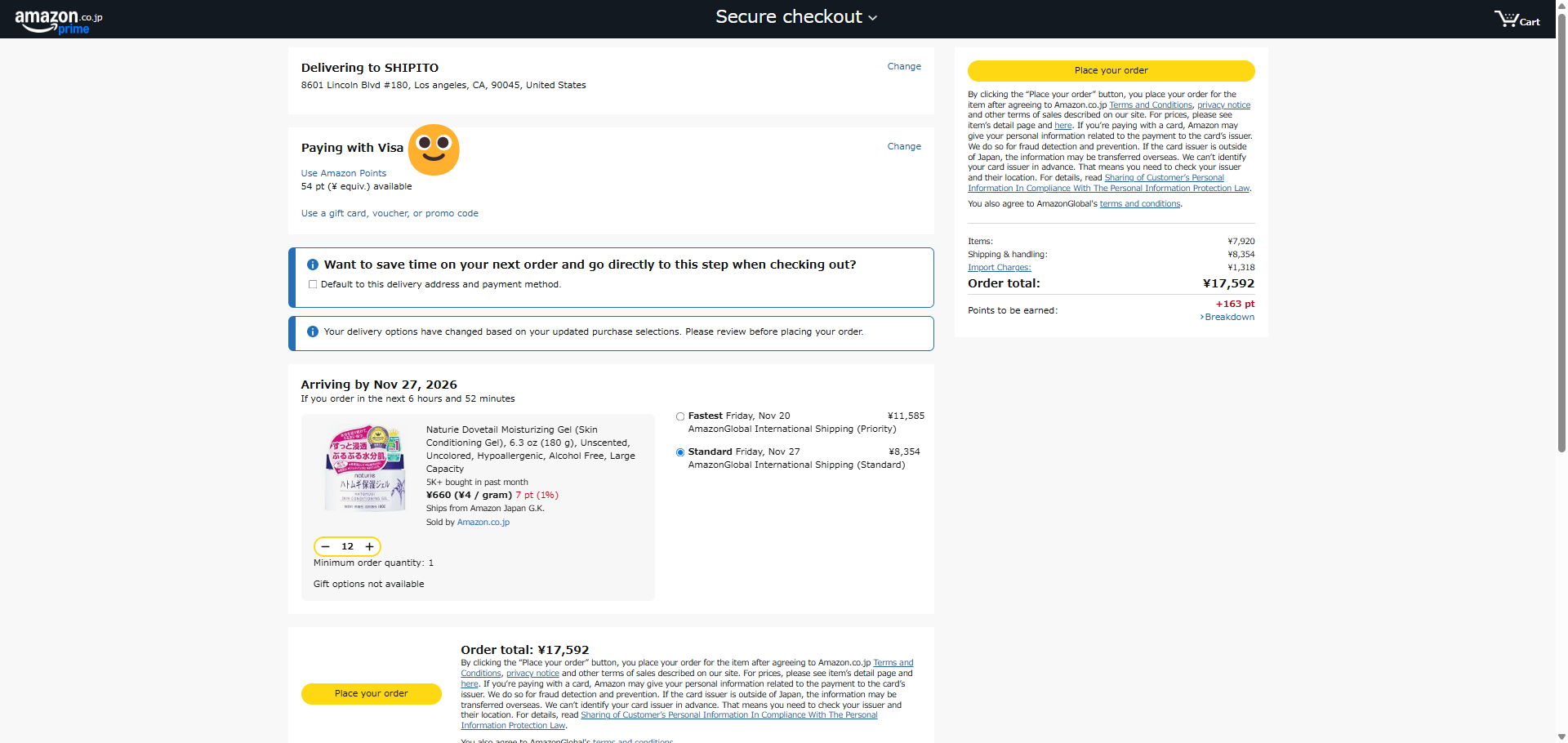
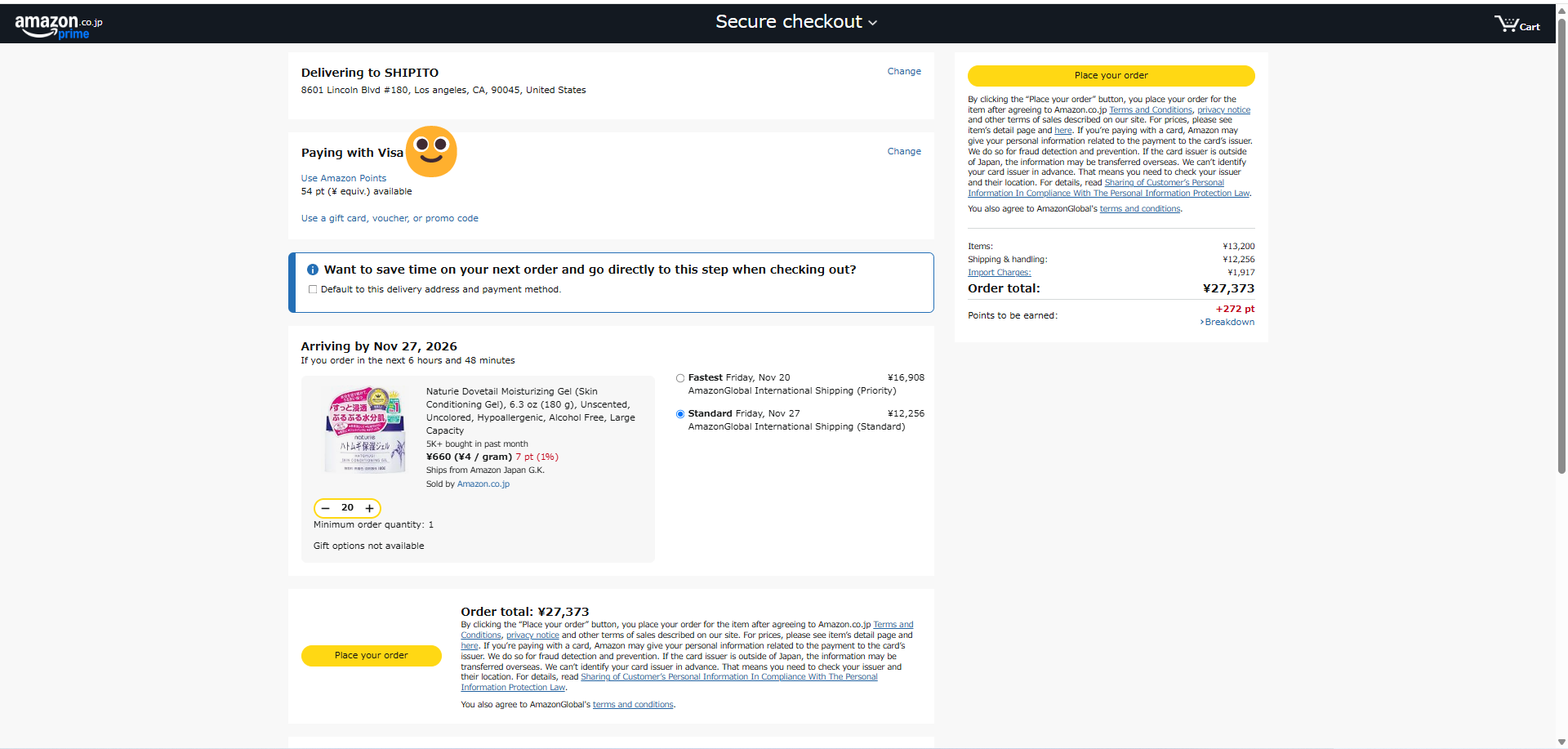
| Quantity | Products | Shipping | Import charges | Order total | Per unit |
|---|---|---|---|---|---|
| 3 | ¥1,980 (≈US$12.39) | ¥3,963 (≈US$24.79) | ¥644 (≈US$4.03) | ¥6,587 (≈US$41.20) | ¥2,195.67 (≈US$13.73) |
| 6 | ¥3,960 (≈US$24.77) | ¥5,427 (≈US$33.95) | ¥868 (≈US$5.43) | ¥10,255 (≈US$64.15) | ¥1,709.17 (≈US$10.69) |
| 12 | ¥7,920 (≈US$49.54) | ¥8,354 (≈US$52.26) | ¥1,318 (≈US$8.24) | ¥17,592 (≈US$110.05) | ¥1,466.00 (≈US$9.17) |
| 20 | ¥13,200 (≈US$82.57) | ¥12,256 (≈US$76.67) | ¥1,917 (≈US$11.99) | ¥27,373 (≈US$171.23) | ¥1,368.65 (≈US$8.56) |
The first result: the order becomes more expensive overall, but each unit carries a smaller share of the total. The cost per gel falls by roughly 37.7% between the 3-unit and 20-unit tests. This is a measured difference in unit cost between two basket sizes, not a claim that the shopper has saved 37.7% of their total spending.
The simple math
Difference per unit: ¥2,195.67 − ¥1,368.65 = ¥827.02 (≈US$5.17), about 37.7% lower per unit. The total order cost increased from ¥6,587 (≈US$41.20) to ¥27,373 (≈US$171.23).
Notice what did not happen: shipping did not become free or remain fixed. It rose from ¥3,963 to ¥12,256. Import charges also rose. Yet the total cost allocated to each unit fell as more items shared the overall order structure.
When does the advantage switch from Amazon USA to Japan?
Our earlier comparison did not stop at a falling cost per unit. It asked a more useful question: at which quantity does the Japanese checkout become cheaper than the product price shown on Amazon USA? We can recover that crossing by using the same four Japanese checkouts, the US listing price of $12.13 per gel and the Bank of Japan reference of ¥159.86 per $1.
For this price-only comparison, we treat the advertised $12.13 as the US baseline. We do not have matching US checkout totals for every quantity, so any US sales tax, delivery charge, or other checkout adjustment could move the true delivered-cost break-even point. This comparison shows a potential price advantage, not savings realized by a buyer.
| Quantity | Japan, all-in per gel | US listed price per gel | Difference on full order | Price comparison |
|---|---|---|---|---|
| 3 | 13.73 USD | 12.13 USD | −$4.81 | JP higher at this benchmark |
| 6 | 10.69 USD | 12.13 USD | +$8.63 | JP lower at this benchmark |
| 12 | 9.17 USD | 12.13 USD | +$35.51 | JP lower at this benchmark |
| 20 | 8.56 USD | 12.13 USD | +$71.37 | JP lower at this benchmark |
At three units, Japan loses: ¥6,587 ÷ 159.86 = $41.20 for the Japanese order, while three units at the US listing price cost 3 × $12.13 = $36.39 before any US checkout adjustments. The US listing subtotal is $4.81 lower.
At six units, the sign changes: ¥10,255 ÷ 159.86 = $64.15 for the Japanese order, while six units at the US listed price total 6 × $12.13 = $72.78. On this comparison, Japan is $8.63 lower.
At twelve and twenty units, the corresponding indicative differences favoring Japan are $35.51 and $71.37 for the entire respective orders. Those are differences against US advertised prices, not verified savings after a US checkout.
Where is the break-even point?
The actual checkouts show the price comparison changing from negative at 3 units to positive at 6 units. The crossing is therefore somewhere between those tested quantities. If we extend the nearly constant additional-unit cost observed between the tested baskets (about ¥1,222.67 per extra gel), the first whole-number quantity estimated to fall below the US listed-price benchmark is 5 units.
Five units is an interpolation, not a tested checkout. Amazon may recalculate shipping or import charges when the quantity changes. To verify an exact five-unit break-even, we would need its actual checkout and matching US delivery costs. The essential KYOTEN insight is already visible: a disadvantage can become an advantage when a constraint changes—and a different product mix can move the threshold again.
3. The less obvious test: what do extra units really cost?
There is another way to read the same checkout evidence. Rather than compare two average prices, look at what happens when the order grows. This is the everyday supermarket logic behind the KYOTEN observation: what is the additional cost of the next set of items?
| Change in order | Extra units | Extra total | Cost per added unit |
|---|---|---|---|
| 3 → 6 | 3 | ¥3,668 (≈US$22.95) | ¥1,222.67 (≈US$7.65) |
| 6 → 12 | 6 | ¥7,337 (≈US$45.90) | ¥1,222.83 (≈US$7.65) |
| 12 → 20 | 8 | ¥9,781 (≈US$61.18) | ¥1,222.63 (≈US$7.65) |
Across the three intervals, the additional cost per unit is remarkably close to ¥1,223. That pattern is observed in these four checkouts only; it is not an official Amazon shipping formula, and we should not assume it applies to any product or quantity.
Why does this matter? Because a product can appear very expensive when ordered alone, yet change its economic role when it becomes part of an existing cart. The right question is not simply “Is the item cheap?” It is “What does adding it do to the complete order?”
International scope of these formulas: KYOTEN–ONE, KYOTEN–MIX and KYOTEN–ADUANA here model cross-border purchases using observed checkout totals that include international freight and import charges. We do not know or claim to reproduce the platform’s proprietary pricing algorithm. These models help identify promising combinations; a checkout verifies the final cost.
Inside KYOTEN: the three formulas behind the shopping strategy
We have shown the screenshots and the change in the cost curve. Now we can explain how to reproduce the reasoning. These are three connected analytical tools—not three new KYOTEN doctrines. The first examines one product, the second examines a cart with different products, and the third checks how delivery and import rules change the result.
Important: the coefficients below are fitted or derived from our test observations. They are not Amazon’s official pricing algorithms. A new image now documents the simulated six-gel-plus-one-mask combined checkout. Different quantities and mixes remain estimates until checked independently.
Formula 1 · KYOTEN–ONE: when you change only the quantity
Let Q be the number of Naturie gels in an order. Using the four Japan checkout totals, our fitted model is:
The first term is the estimated cost that increases with every gel. The other is an estimated shared-cost component, spread over the whole order. The fitted amount of ¥2,919.09 is not a claim that Amazon charges a fixed shipping fee of that amount.
| Gel quantity | Model: per gel | Actual checkout: per gel |
|---|---|---|
| 3 | ¥2,195.73 | ¥2,195.67 |
| 6 | ¥1,709.22 | ¥1,709.17 |
| 12 | ¥1,465.96 | ¥1,466.00 |
| 20 | ¥1,368.65 | ¥1,368.65 |
Example anyone can check: at six gels, ¥1,222.70 + (¥2,919.09 ÷ 6) ≈ ¥1,709.22 per gel (approximately US$10.69). The actual Amazon checkout was ¥10,255 ÷ 6 = ¥1,709.17. The difference is only a few yen cents due to fitting and rounding.
Single-product break-even: Amazon USA shows $12.13 per gel, equivalent to about ¥1,939.10 at our reference exchange rate. Solve ¥1,222.70 + ¥2,919.09 ÷ Q = ¥1,939.10. This gives Q ≈ 4.07, so the first whole-number quantity predicted to become favorable to the Japanese offer is five gels. We observed the sign changing between the three- and six-unit checkouts; five is a model estimate, not its own screenshot.
Formula 2 · KYOTEN–MIX: when the cart contains different products
A shopper may not need five or six identical gels. Let x be the number of Naturie gels and y the number of LuLuLun mask packs. Our general mixed-basket framework is:
Here, d is the delivery destination, K is a shared-cost estimate, the c values are additional product costs, and R covers other changes such as shipping tiers, taxes or import charges that do not follow a straight line.
Our documented hypothetical combined cart contains six Naturie gels plus one LuLuLun pack. Six gels alone total ¥10,255 (≈US$64.15); the combined cart totals ¥13,794 (≈US$86.29). Therefore, adding the mask increases the total by ¥3,539 (≈US$22.14): the product itself at checkout costs ¥2,238 (≈US$14.00), added international freight is ¥1,046 (≈US$6.54) and added import charges are ¥255 (≈US$1.60). The earlier product-page listing showed ¥2,233 (≈US$13.97), but the checkout’s ¥2,238 is the figure used in this calculation. The image appears in Section 4.
Example: one gel and one mask pack produce a modeled total of ¥2,919.09 + ¥1,222.70 + ¥3,539 = ¥7,680.79 (approximately US$48.05). This one-plus-one result remains a model estimate: our new screenshot confirms the six-plus-one checkout, not the one-plus-one combination. The ¥3,539 coefficient is fitted to that specific documented addition and need not hold for other quantities.
This model is a local working approximation for the tested basket. It is not a promise that adding any number of LuLuLun packs will always cost another ¥3,539. A different product combination or quantity can change the transport and tax structure; that change belongs in R.
Formula 3 · KYOTEN’s advantage and customs check
The third step asks whether the composition creates a price advantage compared with buying the corresponding products at the US advertised prices. For the same quantities, let S(x,y) be the US listed-price subtotal minus the modeled Japanese total.
Read the result as a sign: S below zero means Japan is more expensive against these US product-page prices; S above zero means the Japanese modeled total is lower. That is not necessarily the final customer saving because we have no matching US checkout for these mixed baskets.
With one LuLuLun pack (y = 1), the smallest whole-number gel quantity predicted to make the indicator positive is:
At x = 2, y = 1, S ≈ −¥231.09; at x = 3, y = 1, S ≈ +¥485.31 (about US$3.04). This contrasts with the five-gel modeled threshold for a gel-only cart: adding a useful different product can shift the apparent crossing. It does not prove a net saving for either basket without comparing equivalent complete checkouts.
Finally, KYOTEN–ADUANA makes the model usable across countries. For a cart shipped to destination d, the real landed cost is:
Import charges depend on destination, classification, origin, applicable thresholds and the final cart. They must be evaluated from the actual checkout and applicable rules, not treated as a universal flat rate or automatically zero below an assumed threshold.
Our four observed Amazon Japan import charges demonstrate the need for this third check: ¥644 at 3 gels, ¥868 at 6, ¥1,318 at 12 and ¥1,917 at 20. The screenshots do not establish any particular customs threshold being crossed. This is why the cost of a new basket must be recalculated instead of copying a previous average.
What the three formulas do together: KYOTEN–ONE tells us what happens when we change quantity. KYOTEN–MIX tests what happens when we change the combination of products. The advantage and customs check asks whether that new combination still makes economic sense for a specific destination. This is the operator’s method behind the shopping-cart examples—not a guarantee that buying more always saves money.
4. But what if six of the same product are too many?
This is where shopping strategy becomes more useful than simply chasing the lowest average cost. Twenty gels may make the chart look attractive, but a normal household may not need twenty—or even six. Buying unnecessary stock ties up cash and creates storage or expiry risk.
Now introduce a different item the shopper genuinely wants: LuLuLun Over45 Camellia Pink (Moist), a 32-sheet face mask pack. This was not a random filler item chosen merely to increase the basket total. It is a branded skincare product with a defined use and a 32-sheet format, suitable for someone who already buys moisturizing masks.
The LuLuLun manufacturer’s product information describes the Over45 Camellia Pink line as a moisturizing mask intended for mature skin, with a 32-sheet pack for frequent use. Its presence in both the Japanese and US Amazon listings gives us a second real market comparison—not proof that its exact versions, checkout terms and costs are identical.
Why it matters: a useful second product changes the shopping decision. Rather than storing six, twelve or twenty jars of one gel just to lower its average cost, the buyer can test whether a smaller quantity of gel plus masks they genuinely need produces a better overall purchase. The actual combined checkout must decide, not our assumptions.
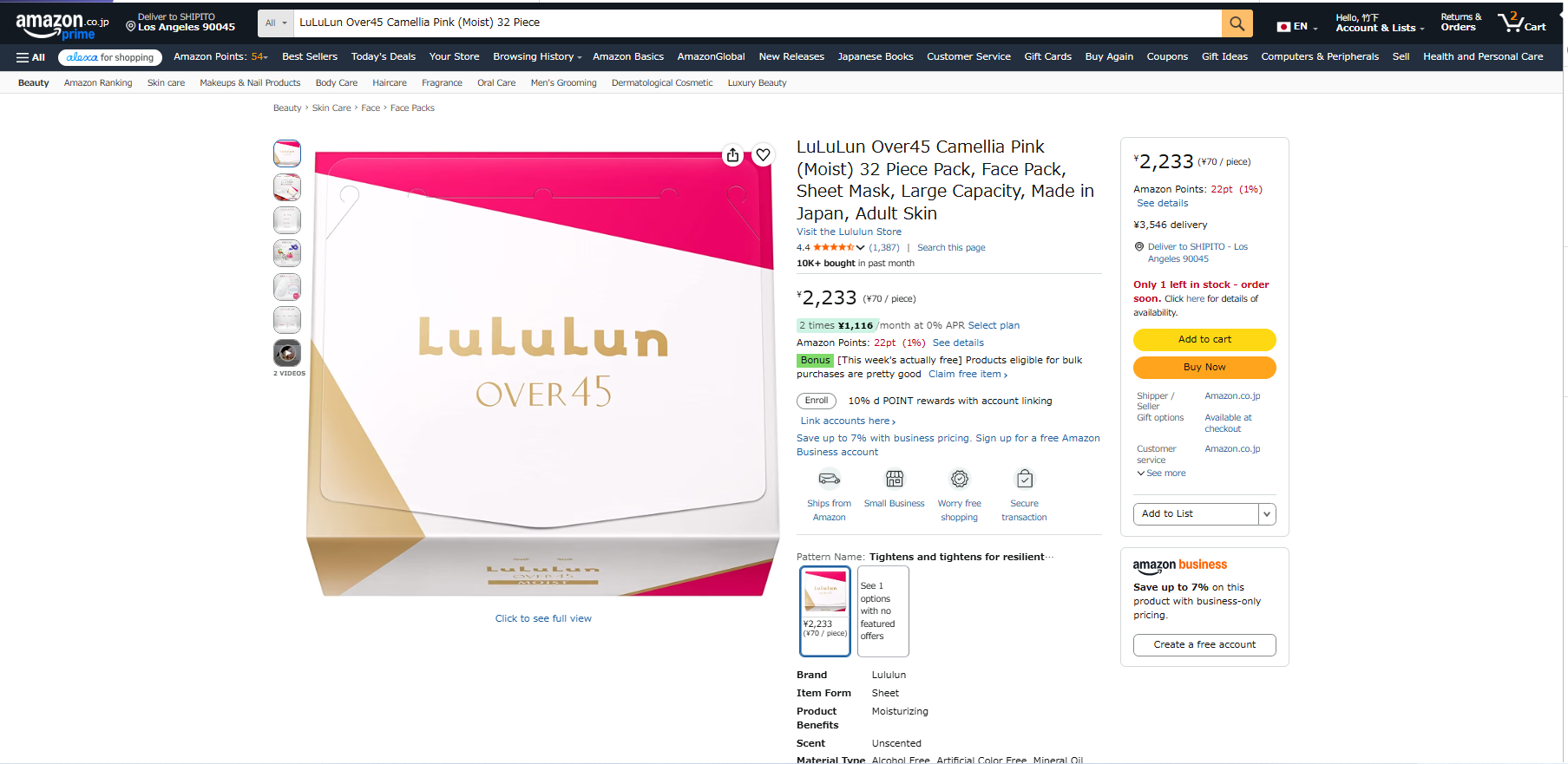
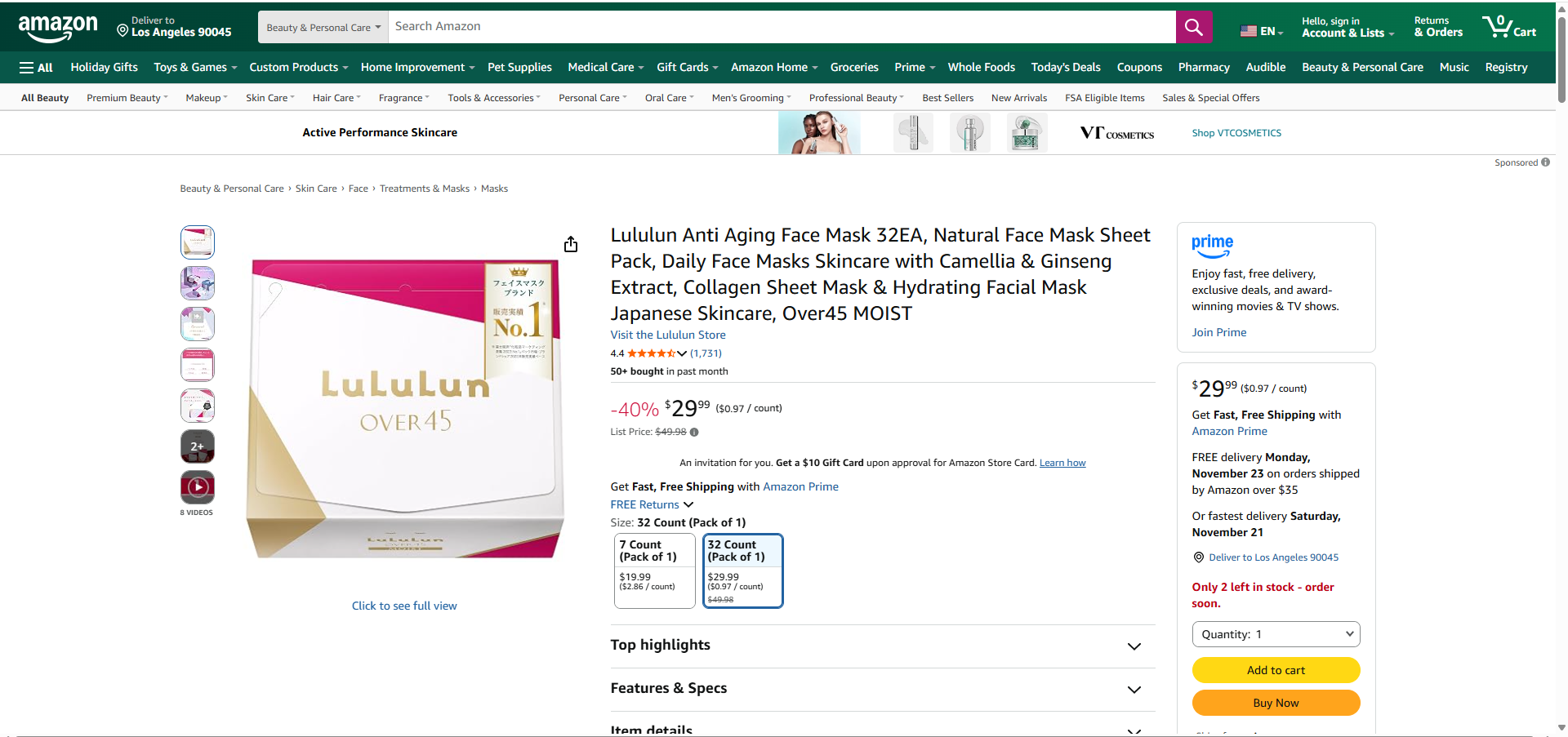
KYOTEN–MIX: the documented hypothetical international combined cart
The following image records a simulated checkout, not a placed order, after adding one needed mask pack to an existing six-gel international cart. This illustrates the cost structure rather than recommending particular brands.
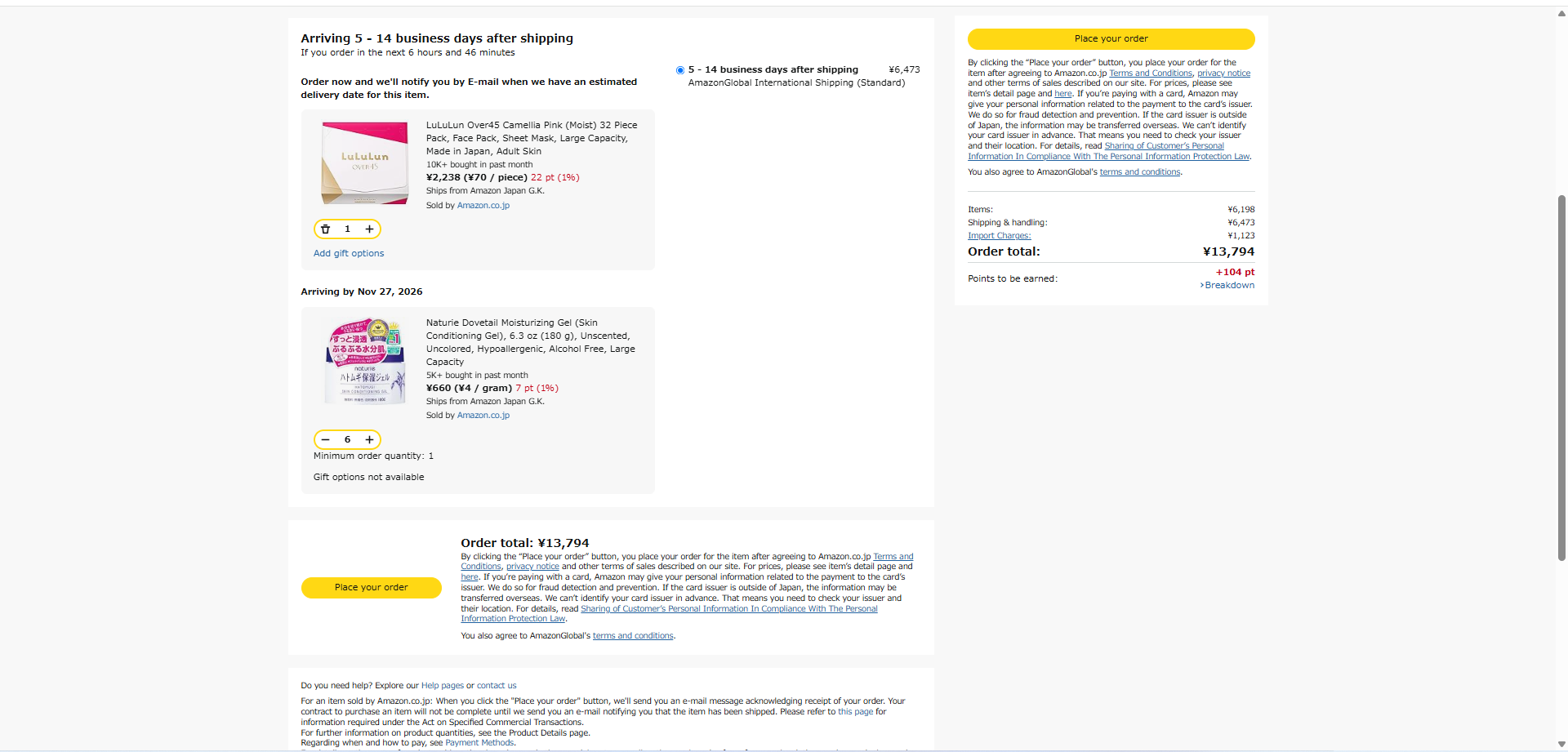
| Checkout component | Six gels | Six gels + one mask | Additional cost |
|---|---|---|---|
| Merchandise | ¥3,960 (≈US$24.77) | ¥6,198 (≈US$38.77) | ¥2,238 (≈US$14.00) |
| International freight | ¥5,427 (≈US$33.95) | ¥6,473 (≈US$40.49) | ¥1,046 (≈US$6.54) |
| Import charges | ¥868 (≈US$5.43) | ¥1,123 (≈US$7.02) | ¥255 (≈US$1.60) |
| Order total | ¥10,255 (≈US$64.15) | ¥13,794 (≈US$86.29) | ¥3,539 (≈US$22.14) |
The mask’s marginal cost of ¥3,539 (≈US$22.14) already includes its purchase price and the added freight and import charges. Its price must not be counted twice. The US product page displayed an advertised 40% discount and price of US$29.99 (≈¥4,794). The difference from the marginal mixed-cart cost is US$7.85 (≈¥1,255), but that is a comparison against a listed US item price, not against a complete verified US delivered checkout. We do not claim realized or guaranteed savings.
A 40% discount is not the answer on its own. Neither is the Japanese product price. We still have to check whether the two variants are equivalent, what actually reaches the Los Angeles checkout, and whether the products can ship together.
How to test a mixed cart without guessing
Suppose the shopper wants three gels and one mask pack, rather than six gels. The Japanese product prices visible in the screenshots let us calculate the merchandise subtotal only:
But ¥4,213 (≈US$26.35) is not the landed cost. The new screenshot documents six gels plus one mask, not this three-gel-plus-one-mask combination; this exact alternative therefore remains a model to verify. Those charges can change with product size, weight, seller, eligibility and destination.
To determine whether combining actually saves money, compare the cost of obtaining the same desired goods in two ways: ordering three gels and one mask pack separately versus ordering those very same goods together. The difference between those two complete checkout totals—not a made-up shipping assumption—is the savings, if any.
The changing break-even point
The quantity at which an order becomes worthwhile is not necessarily a fixed number. It can shift when we replace repeated items with a useful different item, because the product mix can change shipping, import fees and the overall value of the cart.
Documented here: the 3-, 6-, 12- and 20-gel cost curve and the hypothetical six-gel-plus-one-mask total of ¥13,794 (≈US$86.29). Still to verify: a new mixed-cart break-even point or a realized saving against an equally complete destination-market checkout. A screenshot of one combination cannot prove every combination.
5. KYOTEN: see the system, not just the price tag
This is not a new, separate KYOTEN doctrine. It is a practical fusion of its existing principles, used on a problem nearly every online shopper recognizes.
| KYOTEN principle | What it changes in this purchase |
|---|---|
| Metsuke | Shift attention from the single-item price to the whole shopping cart and the relationships among its costs. |
| Binding Constraint | Find the condition that controls the result—shipping, basket size, delivery access, taxes or a product limitation. |
| Tekizai Tekisho | Choose quantities and products that fit real needs, not items added merely to make an average look smaller. |
| Genchi Genbutsu | Go to the actual checkout evidence instead of relying only on a storefront price or a shipping estimate. |
| Verification Gate | Call something an opportunity only when matching goods, destination, total cost and risks have been checked. |
| Kaizen | Repeat the comparison when prices, discounts, products or delivery conditions change. |
The combination matters more than memorizing terminology. It helps us discover why two people with access to the same platform can reach different economic outcomes. One shopper sees an isolated price. The other understands the order as a system that can be redesigned.
Why the Japanese principles are essential to this international method: Metsuke broadens observation from one price tag to the interdependent costs of the whole cart. Tekizai Tekisho means selecting the right product in the right quantity for real consumption—not stocking up merely to improve a graph. Binding Constraint directs attention to the condition actually limiting value, whether freight tiers, import charges or unnecessary stock. Genchi Genbutsu grounds the calculation in observed checkouts, Verification Gate prevents treating an estimate as a realized saving, and Kaizen requires reassessing combinations when conditions change.
6. How to apply the method on your next online purchase
Scope of the steps below: this procedure evaluates international online purchases, not routine local price comparison. Start from goods already needed over a realistic consumption period; include freight and import charges, test reasonable quantities and mixed carts, then verify the platform’s final checkout. An effective local coupon can still be the best option.
- Choose what you really need. Write down the products and reasonable quantities before chasing a promotion.
- Check the full order total. Include shipping, taxes, import charges and any extra handling; not just the product page.
- Test a small quantity. Save the checkout total, then test the next sensible quantity on the same platform and destination.
- Calculate the cost per unit. Divide the complete checkout total by the quantity—but only when comparing the same kind of product.
- Try a useful second product. If the quantity feels excessive, test a mixed cart containing items you already need.
- Compare identical needs. Compare separate orders and a combined order containing the same desired goods. A lower average cost is not enough if you spend more on things you will not use.
- Verify before buying. Check stock, product version, delivery eligibility, returns, and the final checkout total. If a key number is missing, treat the saving as unverified.
Remember: the strategy is not “always buy more.” It is “change one condition, measure what happens, and keep only the change that improves the outcome.” Sometimes the best decision is to buy locally, buy fewer items or not buy at all.
7. What this case proves—and what it doesn’t
The four Amazon Japan checkouts show a quantity effect on unit cost for one 180 g gel in simulated international orders to the same destination. Dollar equivalents use the Bank of Japan reference rate stated above, not an actual converted checkout. The two US listings show advertised discounts, but are not US checkout receipts. The new LuLuLun combined-cart screenshot documents six gels plus one mask at ¥13,794 (≈US$86.29). Compared with six gels alone, the incremental international cart cost is ¥3,539 (≈US$22.14). These are unplaced checkout simulations, not evidence of a completed purchase.
We therefore do not claim a verified cross-country saving, a fixed break-even quantity, a guaranteed saving from the mixed basket, or a universal rule for every marketplace. Our new crossing chart compares Japanese checkout totals with the US advertised unit price, not with an equivalent US checkout. The estimated five-unit point is a model result only, and the Los Angeles destination in these Japanese orders is a Shipito forwarding address rather than a confirmed private home. Prices, exchange rates, product versions, tax and shipping rules change. In this case, the Japanese destination is a Shipito address in Los Angeles; any separate forwarding services beyond the displayed Amazon checkout would need to be evaluated independently.
Evidence date: November 15, 2026. Method: storefront screenshots and four simulated, unplaced Amazon.co.jp checkouts, all using the same Los Angeles shipping destination. This is an independent educational case study, not a seller endorsement or a claim of actual purchase savings.
8. Why a shopping cart can change how you think
A small everyday decision may teach something much larger: the value of a choice can depend on what happens elsewhere in the system. That does not promise success in every business or professional situation. It offers a habit of thinking—observe beyond the visible signal, locate the real restriction, test alternatives and verify the result.
For some readers, that will simply mean a better online purchase. For others, it may open a new question: what else in my work, business or decisions am I evaluating one piece at a time?
The KYOTEN takeaway: Two people can see the same price in the same store. The advantage is not necessarily hidden information. It can come from seeing how the pieces of a decision fit together—and knowing when a different combination changes the result.
Beyond this case: KYOTEN is not a doctrine limited to Japan, cosmetics, shopping, or any one platform. This international-cart experiment is an accessible way to learn a wider principle: decisions can improve when we recognize structural relationships instead of optimizing each element in isolation. The formulas shown here, however, are designed for international purchasing analysis.
About the KYOTEN calculator — international purchases only. This independent model estimates cost relationships in cross-border carts; it is not Amazon’s proprietary algorithm. For the four checkout totals used to fit the quantity model, differences were less than ¥1 (approximately US$0.0063). That close fit does not promise the same precision for new products or combinations: the final platform checkout takes priority. The working calculator, including its HTML, CSS and JavaScript, has been preserved byte-for-byte. Its built-in example note refers to the earlier screenshot set; the newly added six-plus-one checkout image is now displayed above.
Try KYOTEN with your own shopping cart
Now put the method to work. Enter the final totals from two or more checkouts of the same product at different quantities. The calculator will estimate the cost of adding an extra unit, show where the price comparison changes, and let you test a second product instead of buying more of the first.
This calculator starts empty. Enter your own shopping totals or select Load KYOTEN Example to explore the four real checkout simulations. The curve and results appear once enough valid figures are entered. Always verify promising results with an actual checkout.
Online Shopping Cost Calculator
Compare real checkout totals at different quantities. Find the approximate cost of an extra item and test how a different product might change the cost advantage. Works for any store or country.
1. Enter checkout totals
Enter at least two checkouts of the same item at different quantities, using the same destination. Include product prices, shipping and import charges. To learn from our Naturie Hatomugi study, click Load KYOTEN Example. The example represents simulated orders, not completed purchases.
If both prices use the same currency, enter exchange rate 1. The local price is a price benchmark: unless it includes local shipping, tax and other fees, the result is not a verified saving.
2. What the checkouts reveal
3. Unit-cost curve and price crossing
Dots are observed checkout totals divided by quantity. The curve is a fitted estimate, not a retailer’s official shipping formula. The horizontal line is the local advertised unit price.
4. Compare the quantities
The price gap compares actual checkout totals with quantity × local advertised price, converted into the checkout currency. It is not a two-checkout comparison unless you have included all local costs.
5. Add a different product instead of buying more of the same
Product A is the one in your checkout tests. Product B is a different item you genuinely need. To estimate a mixed cart, enter the total additional cost caused by adding B to an A order—not only B’s product-page price. Re-check any resulting combination in a real checkout.
Evidence note: when you select Load KYOTEN Example, the ¥3,539 extra cost for B comes from an earlier KYOTEN mixed-cart calculation, not from one of the nine screenshots in the article. It demonstrates the method, not a new verified checkout. For two or more B products, multiplying a one-item incremental cost assumes a linear rate that the retailer may not use.
How to interpret your results
The fitted cost formula is T(Q) ≈ a + b × Q, with a as an estimated shared component and b as an estimated additional cost per unit. This is a statistical approximation. A change in shipping weight, taxes, customs or seller rules can break the pattern.
To claim a real saving, compare the same required products and a matching delivery destination under two complete checkouts. The calculator cannot independently verify item equivalence, tariffs, availability or future prices. It does not send any of your data to a server.
KYOTEN example: test date November 15, 2026; reference rate US$1 = ¥159.86. Currency rates and offers are editable and may change. The included Los Angeles destination is a forwarding address; onward forwarding costs are not included.
Explore the KYOTEN ideas behind this case
- KYOTEN and the Geographic Asymmetry of Intelligence — why visible market information is not the whole opportunity.
- Commercial Legibility: Why Buyers Cannot Act on Value They Cannot Verify — evidence as a condition for a decision.
- The Operator Mindset — the importance of understanding connected parts rather than isolated figures.
- The AI Tried to Find the Cheapest GoPro in the World — another example of why headline price comparisons can miss important details.
Frequently asked questions
Does buying more always reduce the cost per item?
No. Shipping tiers, taxes, seller rules and weight can change. Our four checkouts show a decline in this case, not a universal rule.
Does the 37.7% lower unit cost mean I saved 37.7%?
No. It compares the average unit costs of different quantities. The 20-unit order costs much more in total than the 3-unit order.
Can adding a different product move the break-even point?
Yes, it can change the economics of a cart, depending on the actual charges and the buyer’s needs. The precise result must be measured with a real combined checkout.
Is Amazon Japan always cheaper than Amazon US?
No. Different discounts, exchange rates, taxes, shipping and product versions can reverse the result. Compare final totals for equivalent goods delivered to the same destination.
Are KYOTEN–ONE, KYOTEN–MIX and KYOTEN–ADUANA designed for local purchases?
No. These three formulas and this calculator are presented here for international shopping, where cross-border freight, import charges and order composition affect the total. KYOTEN as a wider doctrine remains universal.
Do coupons and price trackers still work?
Yes. They can be excellent for local or international product discovery. Their results alone do not prove that the complete international basket has the lowest total cost.
What does the 40% LuLuLun discount example actually prove?
The destination-market listing displayed US$29.99 while adding a mask to the hypothetical six-gel international cart increased the total by ¥3,539 (≈US$22.14). The approximate US$7.85 (≈¥1,255) difference is between an advertised item price and a documented marginal international cost—not between two verified delivered checkouts.
Does the calculator always match a platform within ¥1?
No. Differences under ¥1 (≈US$0.0063) describe its fit to the four original checkout examples used to develop the quantity model. New carts may vary, and only the platform’s current final checkout confirms the amount to pay.