
DISCOVER JAPAN SITES AI
Ask in your language. Get answers with context, not just keywords.
Welcome. What would you like to know?

Updated October 2026: This article preserves an original Discover Japan Sites investigation into suspicious Sony WH-1000XM5 headphone listings. The historical screenshots, advertised prices, and observations remain part of the evidence. This update adds official Sony product information, consumer-protection guidance published after the original investigation, and a clearer distinction between warning signs, reasonable hypotheses, and verified facts.
The Sony WH-1000XM5 Case: How an Online Shopping Investigation Began
Online shopping gives consumers access to products and prices that would once have been difficult to compare. Yet that same convenience creates opportunities for misleading listings, unauthorized imitations, counterfeit goods, and sellers whose claims do not match the products they offer.
One of the most important lessons is that a familiar product name does not automatically guarantee that the item being advertised is authentic.
This became the starting point for an investigation into Sony WH-1000XM5 headphones.
Rather than relying only on the advertised prices, I compared product descriptions, photographs, branding, available colors, visible design details, and customer ratings across different listings.
The results raised questions that deserved closer examination.
An Investigation That Anticipated Later Consumer Warnings
This investigation began before its publication on Discover Japan Sites and preserves the original screenshots of the offers examined.
At the time, the exchange-rate reference used in the research was approximately 148 to 150 Japanese yen per US dollar. This historical reference helps explain the price comparisons. It should not be interpreted as a current exchange rate or as a verified quotation for one specific trading day.
The investigation documented three advertised price levels:
| Historical listing | Advertised price |
|---|---|
| Site A | ¥28,184 |
| Site B — Individual purchase | US$27.21 |
| Site B — Wholesale offer | US$21.70 |
These figures belong to the original investigation. They are not current offers, market quotations, or evidence that the same sellers remain active.
What matters most is that the investigation was already examining warning signs that later appeared in official consumer-protection guidance.
In November 2025, the US Federal Trade Commission warned consumers about fraudulent online advertisements using recognizable brands, unusually low prices, and misleading product offers. Its advice included researching the seller, checking the destination website, protecting payment methods, and keeping purchase records.
Those recommendations closely relate to the questions raised in this original case. This does not mean the FTC investigated these particular listings or relied on DJS research. It means the earlier observations remain relevant to the broader problem of deceptive online sales.
Source: FTC — How to Avoid an Online Shopping Scam (November 2025).
Understanding the Original Sony WH-1000XM5
Before deciding whether an advertised product is authentic, the buyer needs a reliable reference.
For this case, that reference is the official Sony WH-1000XM5 product information.
Sony announced the WH-1000XM5 in Japan on May 13, 2022, with sales beginning on May 27, 2022.
The model introduced several notable technologies and design features:
- Noise cancellation: an integrated processor V1, the HD Noise Cancelling Processor QN1, and eight microphones used in the noise-cancellation system.
- Sound reproduction: a specially developed 30 mm driver.
- Call quality: beamforming microphones and advanced noise-reduction processing.
- Design: a redesigned headband and soft-fit materials.
- Connectivity: Bluetooth and multipoint connection for compatible devices.
- Packaging and materials: design choices intended to reduce environmental impact.
These specifications provide a technical reference against which advertisements can be compared.
Official reference: Sony Japan — WH-1000XM5 Launch Announcement (2022).
The Original Product: A Reference for Comparison
The following screenshot was preserved from the original investigation and shows a Sony WH-1000XM5 product listing on Amazon Japan.
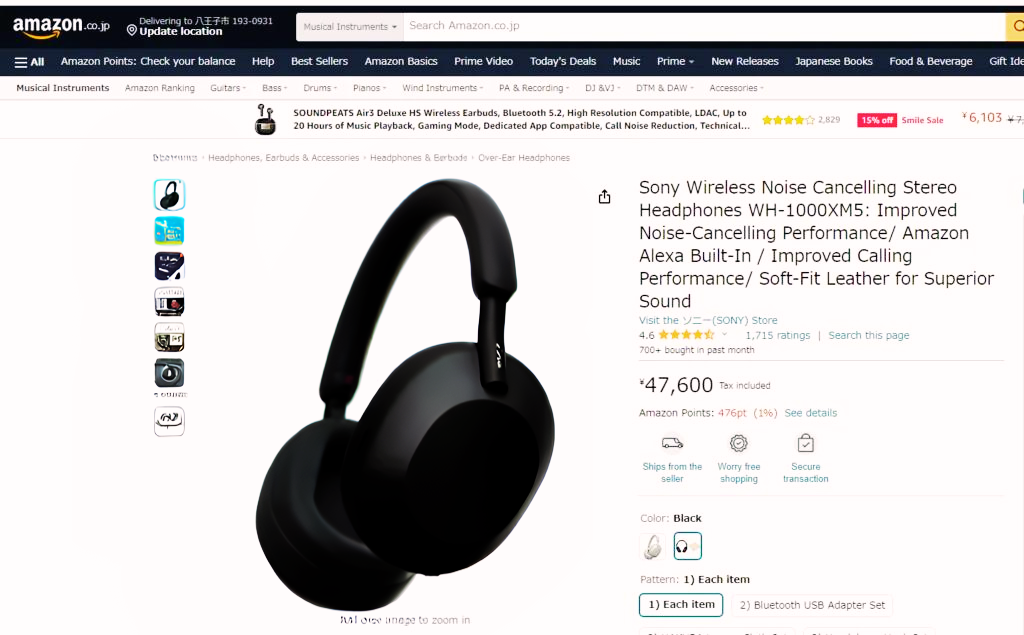
Historical screenshot: Sony WH-1000XM5 product listing examined during the original research. The listing and its commercial details may have changed since the capture.
What Should Be Examined in an Authentic Product Listing?
The model name is only the starting point. A careful comparison should examine several independent details:
- Manufacturer identification: the brand and full model should match Sony’s official documentation.
- Product photographs: the design, logos, controls, and visible construction should be consistent with the manufacturer’s product.
- Available colors: the advertised variant should correspond to an official release for the relevant period and market.
- Product specifications: descriptions should match the official technical features.
- Seller identity: buyers must distinguish the shopping platform from the merchant actually offering the product.
- Reviews and ratings: useful for context, but not independent proof of authenticity.
- Return and payment conditions: these determine what protection may exist if the delivered item differs from the advertisement.
Even a recognizable marketplace or a highly rated listing does not eliminate the need to check the actual seller and the product being offered.
The First Warning Sign: The Same Model Reference, Different Products
Price was the first signal, but it was not the only one.
When comparing the advertisements from Sites A and B, I noticed that both used the WH-1000XM5 model reference while certain visible details did not clearly correspond to the official Sony product presentation.
The investigation therefore raised a more important question than the advertised discount:
Were these different offers for the same authentic product, or different products being presented under a recognizable commercial model reference?
The screenshots documented inconsistencies worth investigating. They did not establish that Sites A and B had a direct commercial relationship or that the products came from the same supplier.
Site A: A Lower Price and Questions About Product Identity
The first advertisement examined offered headphones under the WH-1000XM5 reference for ¥28,184, approximately US$188 to US$190 when using the historical exchange-rate range of ¥148–150 per dollar.
The price appeared attractive compared with the reference product considered during the original investigation.
However, the listing raised additional concerns:
- The model reference was presented without clear Sony branding in the product description examined.
- The advertised colors and visible design details required comparison against Sony’s official variants.
- The listing showed very limited review evidence: one review with a one-star rating at the time of capture.
- The product photographs did not provide the level of visual clarity needed to verify every relevant detail.
None of these observations alone proves a counterfeit. Together, however, they justified further verification before purchase.
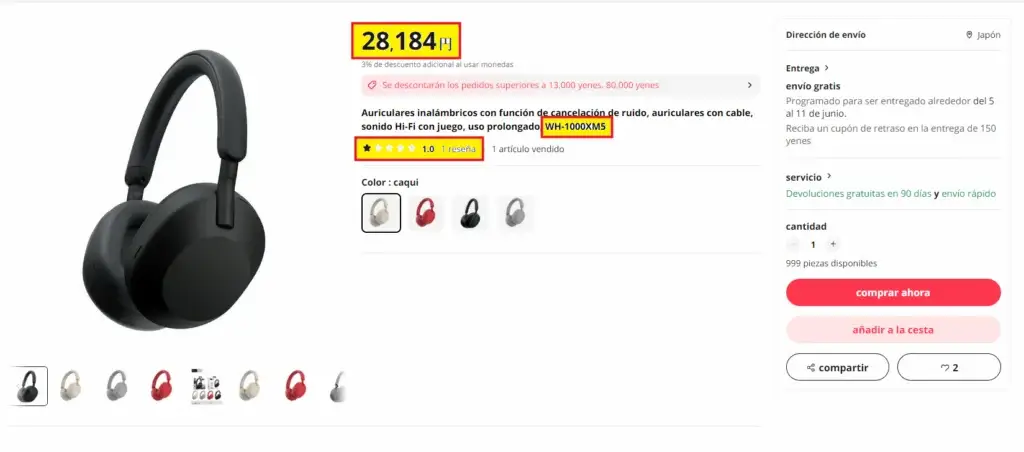
Site A — Historical advertisement preserved from the original investigation. Advertised price: ¥28,184.
Site B: A Much Lower Price and a Wholesale Offer
The second website presented another product under the WH-1000XM5 model reference, with an individual price of US$27.21 and a wholesale offer of approximately US$21.70.
This was a striking price difference, but price alone was not enough to establish that the product was counterfeit.
Several other characteristics deserved attention:
- The listing used the well-known model reference while the visible product branding did not clearly establish Sony authenticity.
- The design and available presentation required comparison with the manufacturer’s reference images.
- The listing displayed a rating of 4.5 stars, approximately 25 ratings, and 29 transactions at the time of the investigation.
- The relationship between the individual and wholesale prices raised questions about possible resale models.
The ratings did not automatically demonstrate fraud, just as they did not guarantee authenticity.
Likewise, although the pricing suggested a possible opportunity for resale at a substantial markup, the investigation could not establish that any particular seller actually followed such a chain.
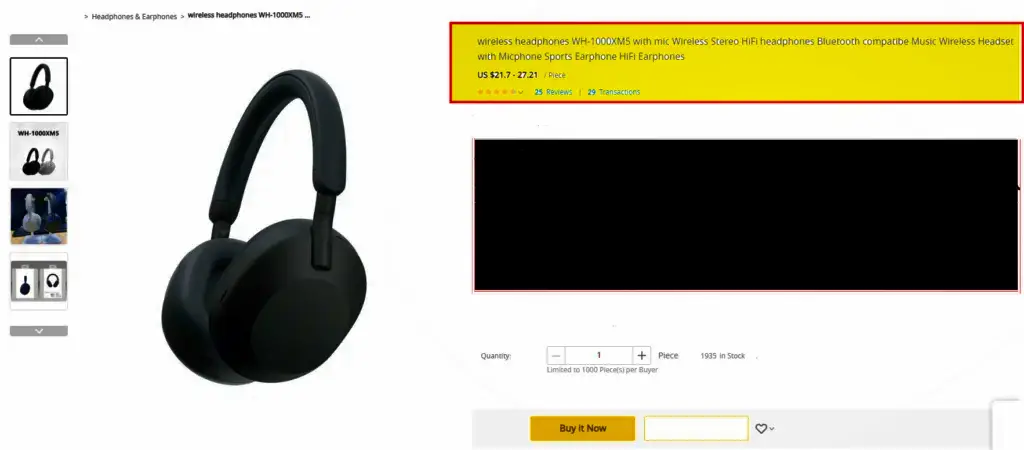
Site B — Historical advertisement preserved from the original research. Individual price: US$27.21. Wholesale offer: US$21.70.
Photographs and Colors: Two Clues That Deserve Closer Examination
During the original Sony WH-1000XM5 investigation, the difference in prices was not the only element that caught my attention.
Some photographs lacked the clarity needed to examine important product details. Blurred images can make it difficult to verify logos, identification marks, connectors, construction quality, and finishing.
It is not possible to conclude that every low-resolution photograph was deliberately used to conceal differences. Poor image quality may have several explanations.
But when unclear images appear alongside other inconsistencies, they deserve more careful investigation.
Why Official Product Colors Matter
Available colors can provide another important clue.
A seller may advertise a recognized model in colors that do not correspond to the manufacturer’s official offerings for that period.
In the case of the WH-1000XM5, Sony’s original Japanese launch announcement of May 13, 2022 listed Black and Platinum Silver as the initial colors.
Sony subsequently introduced additional variants, including Midnight Blue and Smoky Pink in relevant markets. Therefore, the correct comparison must account for the date and market of the advertisement.
A color absent from the original launch is not automatically evidence of a counterfeit if it was officially introduced later.
Sources: Sony Japan — Original 2022 Launch Colors and Sony Electronics — WH-1000XM5 Product Variants.
Five Checks Before Trusting Product Photographs
- Official colors: compare the advertised color with the manufacturer’s available variants at the relevant date.
- Model identification: verify whether the product code matches the claimed version and color.
- Logo and markings: examine whether the branding and identification marks correspond to the official design.
- Image quality: determine whether the photographs allow meaningful inspection of the product.
- Image origin: check whether the merchant uses original photographs, manufacturer images, or generic promotional material.
The lesson is not to reject every blurry photograph or unfamiliar color. It is to establish whether the details of the advertisement are consistent with the product the seller claims to offer.
When price, colors, images, and manufacturer information all raise questions at the same time, the buyer has enough reason to stop and verify before paying.
Original Versus Suspicious Listings: What Can Be Compared?
Some of the original comparisons concerned the physical characteristics of the headphones. These remain useful, but the distinction between visible clues and confirmed technical differences must be preserved.
| Element | Official Sony reference | Warning sign in an advertisement |
|---|---|---|
| Model identification | WH-1000XM5 with Sony branding | Model reference used without clear brand identification |
| Noise cancellation | System incorporating eight microphones and Sony processors | Unclear or inconsistent technical claims |
| Driver | Specially developed 30 mm driver | Specifications inconsistent with official documentation |
| Colors | Official variants corresponding to release date and market | Colors not supported by the manufacturer’s product history |
| External design | Official shape, markings, controls, and finishes | Visible differences that cannot be explained |
| Photographs | Clear manufacturer reference images | Images that prevent examination of important details |
| Packaging | Packaging corresponding to the official product and market | Unexplained differences in layout, marking, or presentation |
Visual inspection cannot confirm every internal component. For example, the actual microphone arrangement or driver inside a product may require physical examination or reliable technical documentation.
A photograph is evidence of what an advertisement displayed, not definitive proof of the internal construction of the item ultimately delivered.
Could Cheap Imitations Be Resold at Much Higher Prices?
The large difference between the prices documented on Sites A and B suggested an important possibility.
Products offered at very low wholesale prices can potentially be resold by intermediaries at considerably higher prices, especially when advertisements borrow recognizable product names or create confusion about the actual manufacturer.
Such a process could expose consumers to misleading product descriptions and pricing.
However, the original investigation did not verify a direct supplier relationship between the two sites.
It would therefore be inaccurate to claim that Site A necessarily obtained its products from Site B.
It would also be inappropriate to describe this possible resale chain as a proven pyramid scheme. A pyramid scheme has a more specific structure, typically involving recruitment and compensation arrangements that were not established in this case.
What was documented was a set of listings with striking price differences and product-identity concerns. The existence of an organized fraudulent resale network remained an unverified hypothesis.
This distinction matters. A strong investigation should make its observations clear without claiming more than the available evidence can support.
Can You Trust a Product with Hundreds of Positive Reviews?
Reviews can help buyers understand product quality, delivery experiences, and seller behavior. But a high average rating is not an authenticity certificate.
In the original research, the reference listing displayed a large number of reviews, while Sites A and B showed very different review profiles.
That contrast was worth examining, but it did not prove that every positive review on the reference listing was genuine or that every unusual rating pattern was fraudulent.
Instead of focusing only on stars, buyers should examine whether reviews discuss the actual model, whether photographs correspond to the product, whether complaints show repeated problems, and whether the merchant can be independently identified.
Do not confuse the reputation of a marketplace with the identity and reliability of every merchant using that marketplace.
How to Protect Yourself Before Paying
Identifying warning signs is useful, but the next question is practical: what should you do before completing the transaction?
1. Check the Manufacturer First
Find the official product page and compare the full model number, specifications, available colors, visible design, and included accessories.
For electronics, even a small difference in a model suffix can identify a different regional version or product configuration.
2. Identify the Actual Seller
Determine who is selling the product, who will issue the invoice, who is responsible for shipping, and who handles returns or disputes.
Research the merchant’s name and website independently. Do not rely exclusively on claims appearing within the advertisement itself.
3. Compare Prices Without Assuming Every Discount Is Fraudulent
A lower price may reflect a legitimate promotion, clearance sale, used condition, renewed product, regional market difference, or older inventory.
But when the advertised price differs dramatically from comparable authentic products, investigate why.
The objective is not to reject bargains. It is to establish whether the bargain is real.
4. Examine Photographs and Request More Detail
Compare official colors, logo placement, construction, packaging, and accessories. If the photographs are unclear, ask for additional images or information where the seller provides that option.
Do not treat a copied manufacturer image as proof that the seller possesses the advertised product.
5. Read the Return and Refund Conditions
Check whether the product can be returned, who pays return shipping, whether international returns are accepted, and which deadlines apply.
A written return policy is valuable, but it is not sufficient proof that an unknown seller will honor it.
6. Choose a Payment Method with Appropriate Protection
Whenever practical, use a payment method that provides documented purchase protection or a dispute mechanism.
Be particularly cautious when an unfamiliar seller insists on payment methods that are difficult to reverse.
7. Preserve the Evidence
Save screenshots of the advertisement, the product description, seller identity, price, payment confirmation, delivery terms, and relevant communications.
These records can be important if the product delivered is different from the one advertised.
The FTC recommends researching unfamiliar sellers, protecting payment methods, and keeping purchase records. See its official online shopping guidance.
What If the Product You Receive Does Not Match the Advertisement?
If the item received differs substantially from what was advertised, begin by documenting the difference.
- Keep the original order details and payment record.
- Photograph the delivered product, packaging, labels, and discrepancies.
- Contact the seller through the platform’s official communication channel.
- Review the platform’s buyer-protection and dispute procedures.
- If eligible, contact the payment provider regarding a dispute or chargeback.
- Report suspected fraudulent activity to the appropriate platform or consumer-protection authority.
Available remedies vary by country, payment method, merchant, and transaction. A refund is not automatic, and dispute deadlines can be important.
The best protection begins before payment, when the buyer still has the opportunity to verify the offer or walk away.
What This Historical Case Still Teaches Us in 2026
The Sony WH-1000XM5 investigation remains useful not because the historical advertisements are necessarily still active, but because the questions raised by the evidence continue to matter.
The case illustrates the importance of combining several independent signals:
- A price that requires explanation.
- A recognizable product reference without clear manufacturer identification.
- Colors that require comparison with official releases.
- Photographs that may conceal, intentionally or otherwise, important product details.
- Ratings that require interpretation rather than blind trust.
- Unverified claims about suppliers, sellers, or product origin.
One unusual detail may have a legitimate explanation. Several inconsistencies appearing together justify a more careful investigation.
This is also why a historical comparison can remain valuable even when products, prices, and sales platforms evolve.
The purpose is not to assume fraud whenever something looks different. It is to recognize when the available evidence is not yet sufficient to justify a purchase.
Conclusion: Investigate the Product, Not Just the Price
The most important lesson from this investigation is that online shopping safety cannot be reduced to the familiar warning that a price may be too good to be true.
Price matters, but so do product identity, official specifications, photographs, colors, seller information, reviews, payment protection, and the ability to verify what is actually being offered.
The original Sony WH-1000XM5 research documented meaningful inconsistencies without requiring the buyer to make a purchase first.
That remains one of the strongest forms of consumer protection: learning to investigate before exposing money to risk.
Japan is not automatically the safest or cheapest market, just as a low-priced offer from another country is not automatically fraudulent.
The objective is to recognize genuine value, identify uncertainty, and make decisions supported by sufficient evidence.
A convincing advertisement is not the same thing as a verified product.
Official Sources and Verification
Source status checked: October 8, 2026. The historical screenshots and listed prices belong to the original DJS investigation. They should not be interpreted as current offers. Manufacturer specifications, available colors, seller conditions, and consumer-protection procedures may change.
- Sony Japan — Original WH-1000XM5 Launch Announcement, May 2022. Official launch date, product features, and original colors.
- Sony Japan — WH-1000XM5 Product Development Interview. Original design, finishes, and manufacturer explanations.
- Sony Electronics — WH-1000XM5 Product Information. Specifications and additional official color variants.
- US Federal Trade Commission — How to Avoid an Online Shopping Scam, November 2025. Warnings about misleading advertisements, suspicious sellers, payment protection, and purchase records.
- US Federal Trade Commission — Online Shopping. General consumer-protection and dispute guidance.