
Most buyers think they are making a complete comparison. They are not. Here is the third map nobody is using.
Most people believe that comparing prices across multiple regions is enough.
Open several tabs.
Check Amazon US, Europe, Japan.
Find the lowest number.
That is exactly what we did in a previous analysis — comparing the GoPro Hero 12 across seven Amazon regions.
Japan came out cheapest.
But even that was not the complete picture.
Because there is a layer beyond regional comparison that almost no buyer ever reaches.
And that layer is where the real structural differences live.
👉 This is not about finding a better deal.
👉 This is about understanding why the deal exists in the first place.
In a previous analysis on DiscoverRenewed, we compared GoPro Hero 12 prices across seven Amazon regions and identified Japan as the base price point. In a second experiment published on DiscoverJapanSites, an AI assistant failed to find that same price — missing by $46. This post explains the structural reason behind both findings — and why the problem goes deeper than any single comparison can resolve for anyone serious about buying from Japan or buying directly from Japan.
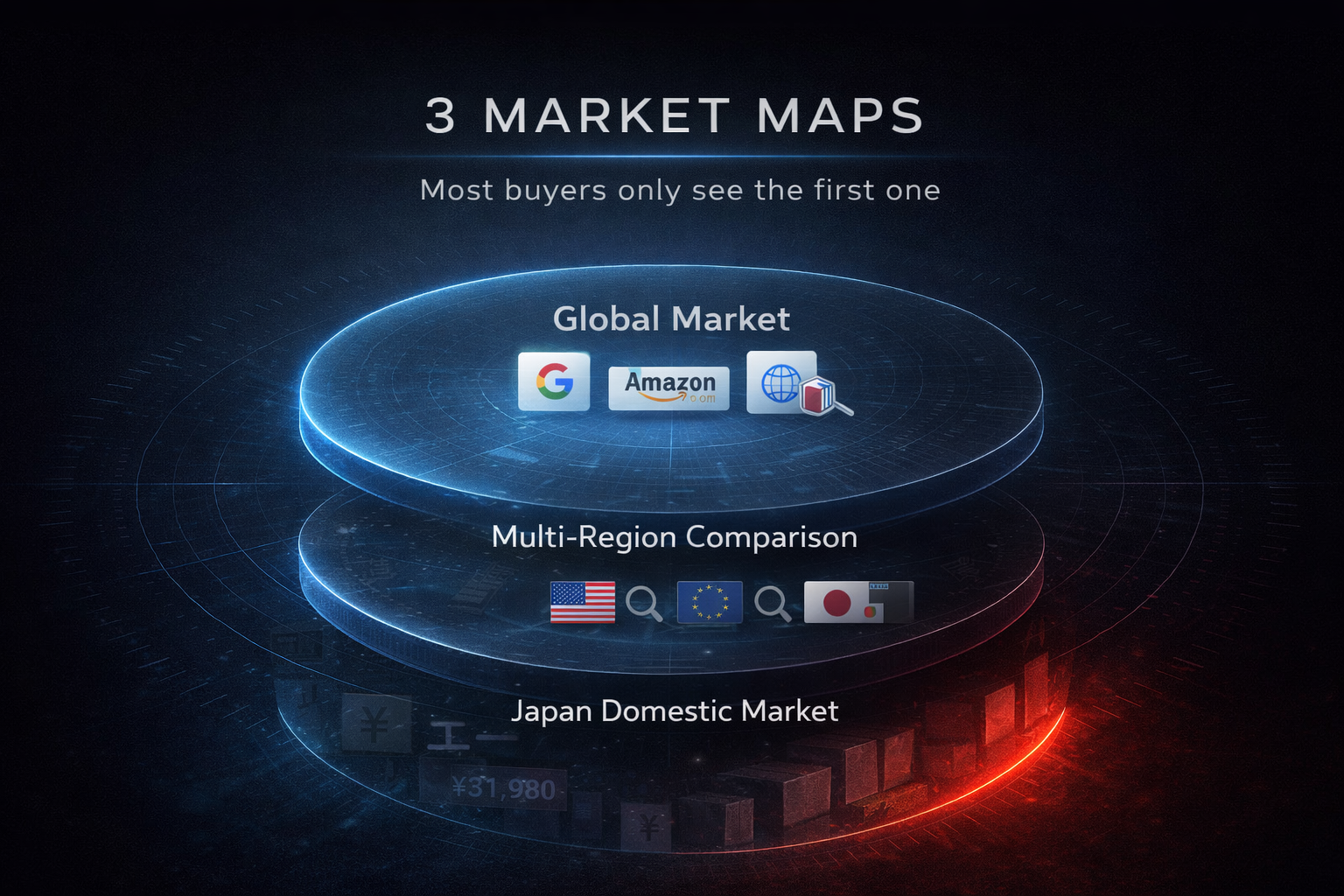
You Have Been Using the Wrong Map — And There Are Three
Most buyers operate with one of three maps.
The first map is what everyone uses.
Google. Amazon.com. Global price comparison tools.
You see what the algorithm shows you.
You see what the majority sees.
It feels complete because everyone around you is using the same map.
It is not complete.
The second map is what informed buyers use.
Multiple Amazon regions. Cross-border comparison.
You see more than most people.
But you are still inside the same system.
Same indexing logic.
Same language structure.
Same global visibility rules.
The third map is where almost nobody goes.
The Japanese domestic market.
Not because it is secret.
Not because it requires special access.
But because it operates under a completely different structure — and most buyers never realize it exists as a separate layer.
👉 That is where the $46 difference came from.
👉 That is where the real structural gap lives.
Why the First Two Maps Create a False Sense of Completeness
When you compare prices across seven Amazon regions, it feels like a complete answer.
It is a better answer.
But it is still a filtered answer.
All globally visible Amazon regions share the same infrastructure.
- Listings indexed for international visibility
- Prices adjusted to international perception
- Inventory aligned with global distribution logic
Even when prices differ between regions, they remain tied to the same visibility system.
They move together.
They react to similar signals.
They remain inside the same global layer.
👉 The Japanese domestic market does not follow those rules.
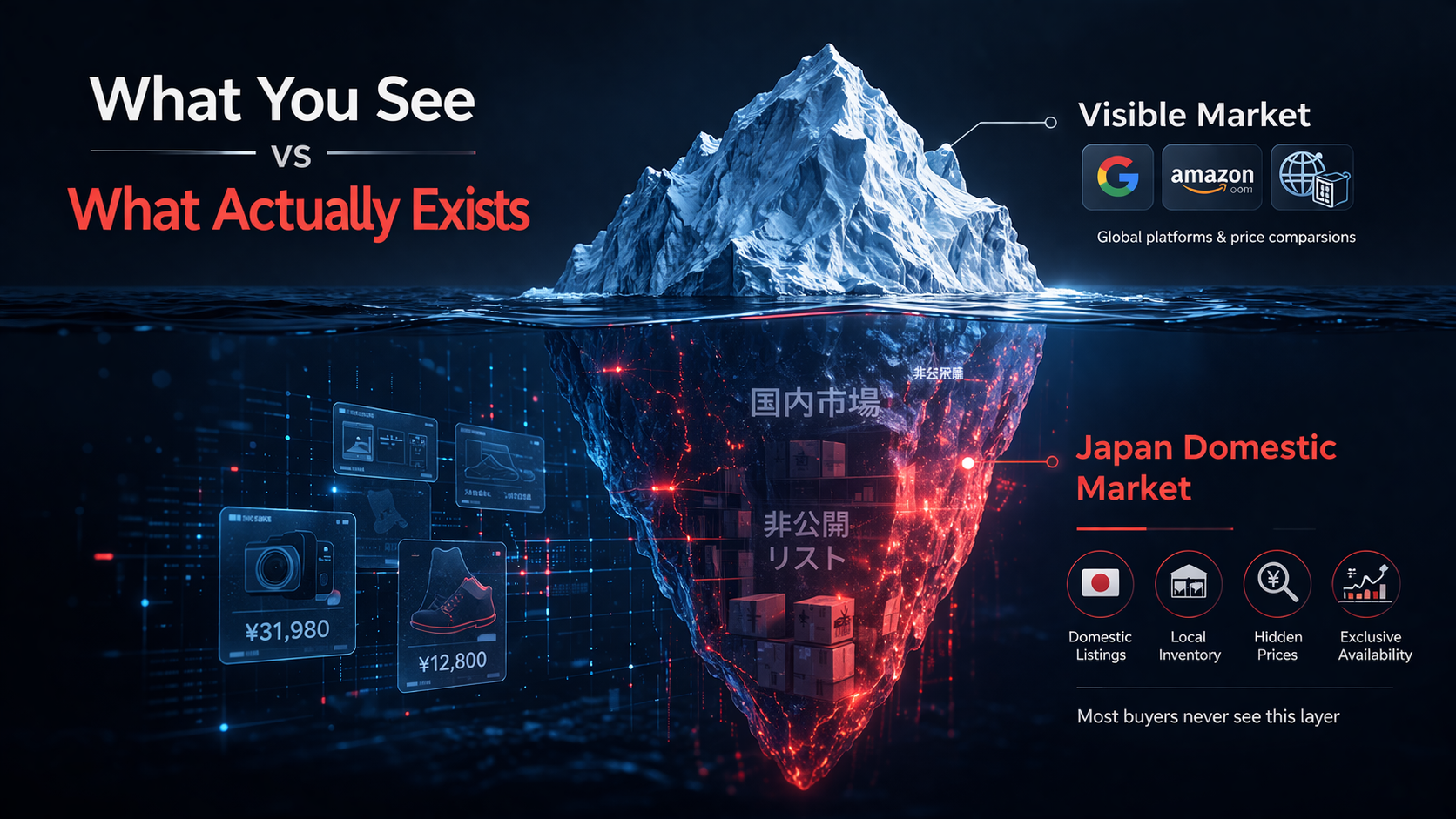
The Hidden Layer No Price Comparison Tool Covers
There is inventory inside Japan that never enters global comparison systems.
Not because it is restricted.
But because it exists in a different language, under different listing behavior, within a market structure that was never designed for international visibility.
This includes:
- Domestic-only listings
- Local inventory cycles
- JDM specifications
- Independent pricing logic
When you compare visible prices across regions, you are still comparing the visible layer of each market.
👉 You are not seeing the domestic layer of the Japanese market.
That layer requires something different.
Not a better algorithm.
👉 A different point of observation.
Japan Domestic Market — The Pricing Structure Global Buyers Never Access
This is not another marketplace.
It is another structure entirely.
The Japanese domestic market operates under conditions that consistently produce pricing behavior invisible to global buyers:
- Corporate upgrade cycles that release near-new units into the domestic second-hand market
- Inventory rotation pressure under local timing instead of global timing
- JDM specifications that differ from export-facing versions
- Currency asymmetry that benefits buyers when the yen remains weak
This is not a temporary discount.
👉 It is a structural condition.
And structural conditions persist until the structure changes.
What Amazon Japan Showed That Global Marketplaces Didn’t
Instead of accepting the AI’s answer, we stepped outside the visible layer of global marketplaces and checked the Japanese domestic market directly.
This is where the approach changes.
Global tools aggregate what is already indexed, translated, and exposed to international buyers.
They operate within a structured layer designed for visibility.
The Japanese domestic market does not follow that logic.
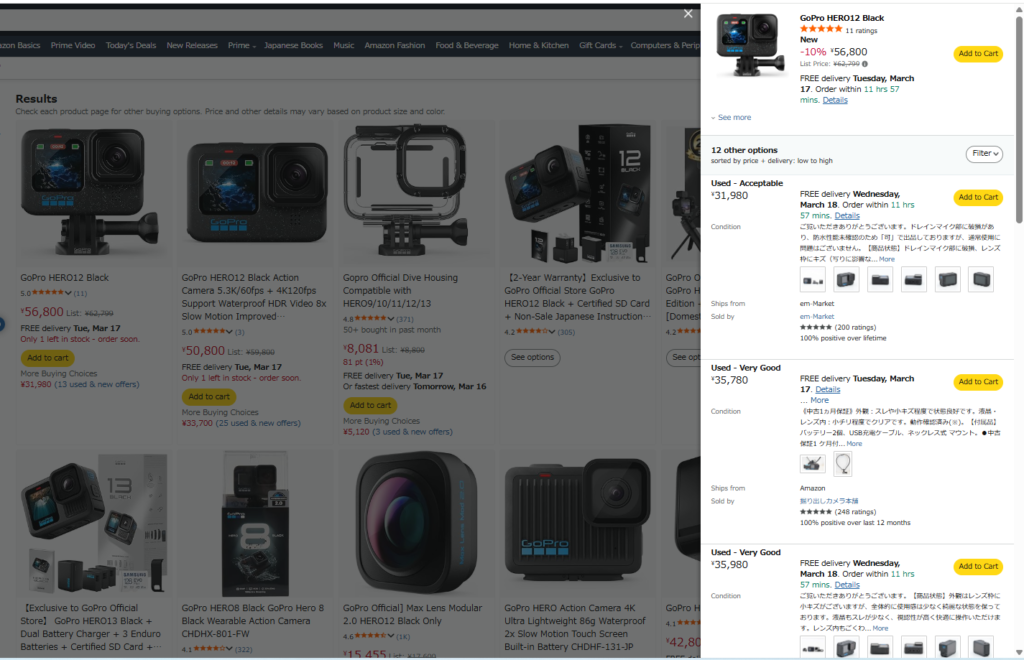
And there it was:
GoPro Hero 12
¥31,980
≈ $201 USD
At first glance, it looks like a simple price difference.
It is not.
This listing exists inside a domestic pricing environment shaped by factors that global platforms do not fully capture:
- inventory rotation within the local market
- pricing inertia in yen-based listings
- domestic demand cycles that differ from global trends
- reduced exposure to international arbitrage
What the AI returned was not incorrect data.
It was incomplete context.
It reflected what was visible across global marketplaces — primarily US-based listings — where pricing tends to converge due to competition, fees, and international demand.
What it did not see was the domestic layer where pricing behaves differently.
This is the critical distinction.
Two buyers can search for the same product at the same time and receive completely different price realities depending on the layer they are accessing.
One sees the global market.
The other sees the domestic market.
And that difference, in this case, was $46.
This is not about finding a “better deal.”
It is about accessing a different market structure — one that is not always indexed, not always translated, and not always visible to automated systems. That is exactly why buyers interested in buying from Japan need more than standard price comparison tools.
Why the Same GoPro Hero 12 Can Be $46 Cheaper
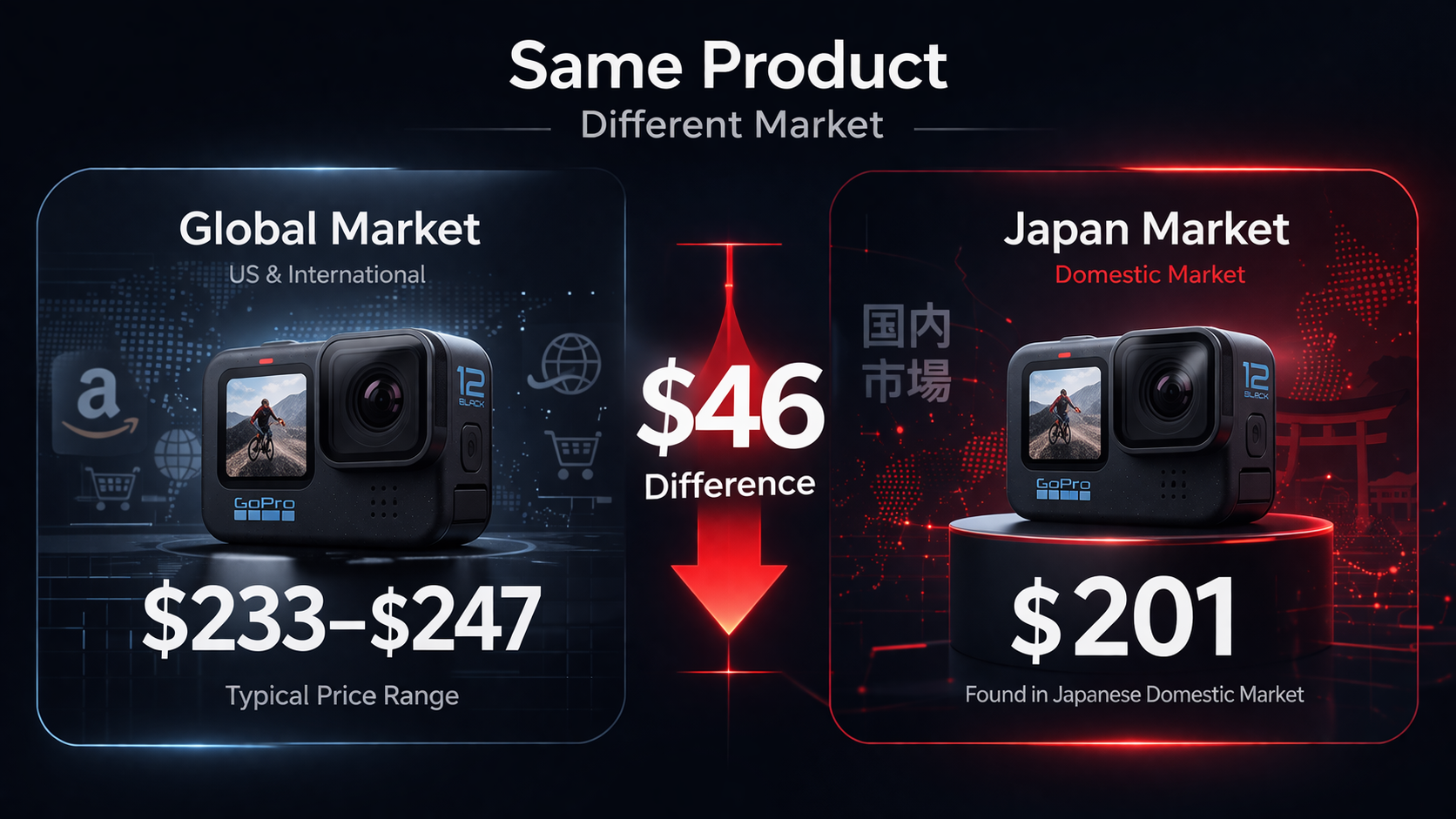
An AI analysis estimated the price between $233 and $247.
But inside the Japanese domestic market:
¥31,980 ≈ $201 USD
Global market: $233 – $247
Japan domestic market: $201
Difference: up to $46 less
Same product. Different market layer. $46 difference.
This price was not found by an algorithm.
It was found by someone operating inside the structure of the Japanese domestic market.
Observing how inventory moves.
Understanding when a price is structural.
Recognizing when a signal is real.
That difference is not computational.
👉 It is contextual.
The Right Question to Ask Before Buying Any Camera From Japan in 2026
Most buyers ask:
Where is it cheapest?
That is the wrong question.
The right question is:
👉 Where is the market behaving differently?
Because price is not the opportunity.
Structure is.
The Weak Yen — A Structural Window With No Fixed Expiration
Japan received over 37 million tourists in recent years — largely driven by currency advantage.
People spent thousands traveling to access that price difference.
But the same condition exists online.
Accessible from anywhere.
Without the flight.
Without the hotel.
👉 Millions traveled for something available from home.
This window is not permanent.
When the yen strengthens, the advantage compresses.
Nobody knows when.
👉 But those who understand the structure act before that happens.
Japan Market Radar — Detecting Structural Signals Before They Become Visible Globally
This is not a deals forum.
It is not a list of discounts.
Japan Market Radar tracks:
→ inventory rotation
→ domestic price divergence
→ JDM anomalies
→ currency-driven signals
These appear before global platforms react.
For serious readers interested in buying directly from Japan, this is where structural signals begin before the global market even notices.
👉 Access the live signals here:
https://www.skool.com/japan-market-radar-1793/classroom/546d31bc?md=988c9cc0bdea47b5baa49f67138a8c03
Beyond Comparison — Understanding Why the Structure Exists
Detecting the signal is only the first step.
Understanding why it exists is another level entirely.
That is what KYOTEN is built for.
Not to find deals.
👉 To read the market before the deal appears.
👉 KYOTEN Premium:
https://www.skool.com/discoverjapansites-4587
Conclusion
The cheapest GoPro Hero 12 in 2026 is not hidden.
It is not exclusive.
It simply exists outside the map most buyers are using.
The first map shows you what everyone sees.
The second shows you more than most.
The third shows you where the structure behaves differently.
And until you change the map,
👉 you will keep finding the same answers everyone else finds.
That is the difference between casual comparison and structural intelligence. And for anyone evaluating cameras, electronics, or any other product category, that difference changes the entire logic of buying from Japan.
Frequently Asked Questions About Buying from Japan and Price Comparison
Is it safe to buy a used GoPro Hero 12 from Amazon Japan when buying from Japan internationally?
Yes. Amazon Japan maintains strict seller standards. A seller with high ratings in Japan is a strong reliability signal. The main barrier is language, which can be easily switched to English.
Does the weak yen still make buying from Japan worthwhile in 2026?
Yes. The weak yen continues to create structural price advantages. This condition will not last forever, which makes timing critical.
What is the JDM market and why does it produce lower prices?
JDM refers to the Japan Domestic Market. Products are designed and distributed locally, often with different specifications and quality standards. Combined with local inventory cycles, this creates pricing opportunities not visible globally.
Why can’t AI find these prices automatically?
Because AI relies on indexed global data. The Japanese domestic market operates outside that visibility in many cases, creating blind spots.
What is the difference between Japan Market Radar and a price comparison tool?
Price comparison tools analyze visible markets. Japan Market Radar detects structural signals inside the domestic Japanese market before they become visible globally.