
DISCOVER JAPAN SITES AI
Ask in your language. Get answers with context, not just keywords.
Welcome. What would you like to know?
What Happens When You Leave Japan? Visit Japan Web, GREEN/RED Customs checks, luggage, Duty Free, airport time and the decisions that matter before boarding.
Important: the new airport procedure is not yet operating
Japan’s new tax-free Refund Method applies to eligible purchases made from November 1, 2026.
This guide uses only procedures already published by official Japanese authorities. The system has not yet begun operating with real travelers, so Discover Japan Sites will not publish assumed airport waiting times, assumed GREEN/RED ratios or predicted congestion as established facts.
Confirmed rules are labeled as confirmed. Travel advice is labeled as Travel Intelligence. Structural interpretation is labeled as KYOTEN Analysis. Unknown operational data remains unknown.
Part 3 will be published after implementation, when actual airport operation can be documented rather than predicted.
Part 1 Explained the Purchase. Part 2 Explains the Exit.
Under the new system, buying tax-free goods in Japan can create a task that follows the traveler all the way to the airport.
If you have not read Part 1, start there:
Japan Tax-Free Shopping 2026: New Refund Rules for Travelers
Part 1 explains the new Refund Method, the ¥5,000 minimum, 90-day rule, consumables, Duty Free, price asymmetry and how to decide before buying.
Part 2 starts at the point where most ordinary shopping guides stop:
The New Order at the Airport
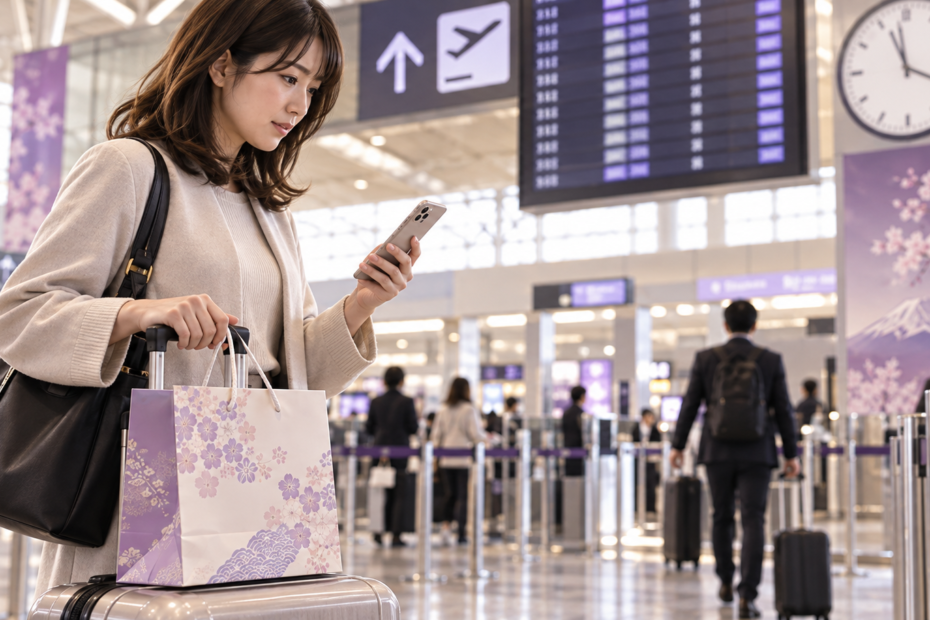
From November 2026, travelers must complete the tax-free Customs confirmation before checking in baggage that contains tax-free goods.
After that come the ordinary airport steps: baggage check-in where applicable, security, departure/immigration procedures and boarding.
Visit Japan Web: What It Really Does
Visit Japan Web is an official Japanese government service operated by the Digital Agency. Under the new Refund Method, it gains an additional airport role for tax-free departure procedures at major airports.
At Narita, Haneda, Kansai, Chubu, Fukuoka, New Chitose and Naha, travelers may complete the tax-free procedure online through Visit Japan Web within the designated wireless-LAN area of the international departure lobby, up to the security checkpoint.
This is important because Visit Japan Web can replace the physical tax-free terminal step at those airports.
But it does not mean that you can finish the final export confirmation from your hotel, train or home before arriving at the airport.
| What travelers may assume | What the new procedure actually means |
|---|---|
| “I registered on Visit Japan Web, so my refund is already approved.” | No. Final departure confirmation still occurs in the designated airport procedure area. |
| “Visit Japan Web removes Customs.” | No. It can replace the kiosk step, but Customs retains authority to require inspection. |
| “If I receive GREEN, I go to a Customs counter anyway.” | No additional physical tax-free Customs inspection is required for that GREEN result. |
| “GREEN means I can skip security and immigration.” | No. It only completes the tax-free Customs procedure. Normal airport departure steps still remain. |
GREEN: What Happens If No Physical Inspection Is Required?
If the terminal or online procedure returns a GREEN result, Customs inspection is not required and the tax-free Customs confirmation procedure is complete.
RED: What Changes?
If the result is RED, additional Customs inspection is required. The traveler must follow Customs instructions and be able to present the tax-free goods.
Until you know whether you have GREEN or RED, your tax-free goods should remain physically accessible.
Why You Must Do This Before Checking Your Suitcase
Imagine that you put a camera, cosmetics and other tax-free purchases into your large suitcase.
You check that suitcase with the airline.
Then you complete the tax-free procedure and receive RED.
Now Customs wants to see the goods.
The Japan Tourism Agency states that checked baggage cannot simply be retrieved after airline check-in for the purpose of completing the tax-free procedure.
That is why the sequence matters:
tax-free confirmation → Customs if required → baggage check-in → security → departure.
Visit Japan Web Can Reduce Friction — but It Does Not Remove the Border
Visit Japan Web digitizes the first layer of the departure procedure. It does not remove Customs authority.
Visit Japan Web can eliminate the kiosk step. GREEN can eliminate the physical tax-free inspection step. RED cannot.
This distinction is also important when thinking about possible airport congestion.
The total number of travelers using tax-free does not equal the number of travelers who will require human inspection.
The key variable is how many travelers receive GREEN versus RED.
As of September 21, 2026, the system has not launched, so DJS does not have post-implementation evidence for the real GREEN/RED ratio or the real waiting time associated with RED inspections.
Domestic Connection Before an International Flight
If your itinerary contains a domestic flight before you finally leave Japan, the tax-free procedure is tied to the point where you actually depart Japan.
Sapporo → Haneda → Los Angeles
Your final departure from Japan is Haneda. That is where the relevant departure tax-free procedure must be completed.
For unusual itineraries such as cruises or fly-and-cruise travel, consult the official traveler FAQ because the exact final-port rule matters.
An Alternative Route: Airport Duty Free
For goods you have not yet purchased in the city, there is another route that becomes more interesting under the new Refund Method:
A genuine airport Duty Free purchase made in the international restricted departure area is different from an ordinary city tax-free purchase.
For that airport Duty Free purchase, you are not using the new city Refund Method sequence of:
pay tax → airport confirmation → refund.
Instead, the goods are sold under the airport Duty Free framework to a departing international passenger.
Duty Free can therefore be a useful friction-reduction option for products that are available at a competitive airport price.
Do Not Wait Until the Airport to Discover the Stock
A major advantage is that several large Japanese airports already provide official online Duty Free catalogs and advance reservation systems.
This changes Duty Free from a last-minute airport purchase into something that can be planned during the trip. A traveler can check the exact product, compare the airport price against the real city selling price, review whether the item is available for reservation and decide whether it makes sense to postpone that purchase until departure.
That distinction becomes more valuable under the November 2026 Refund Method. If a product can be reserved at the airport at a competitive price, the traveler may be able to avoid adding that particular purchase to the city tax-free workflow altogether.
Pre-order does not mean “assume it will be there.” Use the official airport site, complete the reservation process and follow the operator’s confirmation rules before relying on the item.
The practical goal is simple: compare first, confirm stock, then decide whether to buy in the city or collect at the airport.
Kansai International Airport — KIX
KIX accepts normal online pre-orders from 25 days before departure until 5:00 p.m. on the day before the flight for regular flights. Marked Same Day Pickup products can be ordered up to 3 hours before departure.
The reservation site is also a price-comparison tool: only products listed on the website can be reserved, so the traveler can see in advance whether the desired item is actually part of the airport catalog.
Online payment: Alipay and WeChat Pay. Payment at pickup: cash and major cards including Visa, Mastercard, JCB, Amex and Diners, among other methods. KIX states that the sales contract is finalized when the product is handed over, even when online payment is used.
Narita — JAPAN DUTY FREE
Narita’s official reservation site accepts orders 14 to 2 days before departure. After the request is placed, the operator checks stock and sends a confirmation email when the product is ready.
This confirmation step matters: the traveler should not build the shopping plan around the item until the stock check has been completed.
Narita allows advance payment or payment at pickup. Its online credit-card system supports 3D Secure authentication, while local payment includes cash, cards and other accepted methods.
Haneda — TIAT / JAL DUTYFREE
Haneda also offers advance reservation and pickup services. The airport’s official pages identify dedicated reserved-item pickup counters after security.
One useful detail is that TIAT states that products normally handled only in Terminal 3 can, in some cases, be reserved online and collected through the designated pickup service.
This illustrates why the reservation site can provide access that is not obvious from simply walking past one terminal store.
The practical advantage is not only avoiding a stock surprise. It is that the traveler can make the comparison while still in the city. If the exact airport product is confirmed and the price is attractive, the purchase can be intentionally left for departure day. If the item is unavailable, too bulky, or the price is not competitive, the traveler still has time to buy it in Japan before leaving.
This turns Duty Free into a second shopping channel rather than a last-minute gamble.
City shopping gives the traveler a much larger universe of products. Airport pre-order gives something different: greater certainty for a selected item once the reservation is confirmed.
City = broader inventory. Pre-order Duty Free = stronger certainty for selected stock.
Do Airport Duty Free Prices Actually Beat the City?
There is no universal answer. Duty Free can simply remove tax, can offer an additional price advantage, or can still lose to a discounted city retailer.
That is why the correct method is to compare live prices before deciding.
| Verified example | Domestic reference | KIX Duty Free price | What it shows |
|---|---|---|---|
| Clé de Peau Beauté Correcting Cream Veil 40g | ¥8,250 tax-in → ¥7,500 mathematical pre-tax equivalent | ¥7,500 | Duty Free essentially removes the standard consumption-tax component; the main extra value is convenience. |
| Suntory Whisky The Chita 700ml | ¥6,000 recommended retail price before tax | ¥5,700 | About 5% below the manufacturer’s pre-tax recommended price. |
| Maker’s Mark 700ml | ¥3,400 recommended retail price before tax | ¥2,900 | About 14.7% below the manufacturer’s pre-tax recommended price. |
Price check date: September 21, 2026. These examples use current published prices to demonstrate the comparison method. They do not prove that the airport is always cheaper than every city retailer. Sales, points, retailer discounts and limited campaigns can change the result.
This is why DJS does not tell the traveler simply to “buy Duty Free.” We provide the official price doors so the traveler can check the live airport price against the price actually available in the city.
Duty Free is not a promise of the lowest price.
Its value can come from a combination of tax treatment, airport-exclusive inventory, reservation certainty and reduced refund friction.
Some Duty Free Products Are Different Products — Not Just Cheaper Products
Airport Duty Free should not be confused with Japan’s domestic market.
Some airport products are specifically marked Duty Free Exclusive, Travel Retail Exclusive or Japan Airport Limited.
For example, KIX currently lists:
- Hakushu Japanese Forest 700ml — ¥19,000 — Duty Free Exclusive
- Hibiki Japanese Harmony Master’s Select 700ml — ¥17,000 — Duty Free Exclusive
- Hakushu 25 Years Old Japan Airport Limited Edition — ¥480,000 — Duty Free Exclusive / Online Only
- SAKURAO Single Malt Japanese Whisky TR Exclusive — ¥6,000
- KIX Duty Free Exclusive SAKURAO Single Cask #7776 — ¥26,000
JDM, Japan Limited and Duty Free Exclusive Are Not the Same Thing
This distinction matters because a first-time traveler may simply see all three as “Japanese products.”
A traveler who only wants “a good watch,” “a good camera” or “a Japanese whisky” may not care which channel produced the item. But a traveler looking for a specific reference can care enormously. A JDM watch, a Japan-only electronics model, a store-limited collaboration and an airport travel-retail edition can be completely different buying targets even when they belong to the same brand.
This is why Duty Free should not be presented as a replacement for Akihabara, Ginza, specialist camera stores or domestic brand boutiques. Airport retail is optimized for departing international passengers; city retail is where the traveler is more likely to find the depth of models, variants and domestic-market references that make Japan itself the destination for the search.
| Category | What it generally means | Where you are more likely to find it |
|---|---|---|
| JDM | Japan Domestic Market product or version intended primarily for the Japanese market. | City retailers, specialist stores, electronics districts and brand stores. |
| Japan / Store / Region Limited | A limited edition sold in Japan, in a specific chain, store or region. | Depends on the edition; often city or regional retail. |
| Duty Free / Travel Retail Exclusive | A version created for the international travel-retail channel. | Airport Duty Free and related travel-retail channels. |
| Japan Airport Limited | A product or edition specifically limited to Japanese airport retail. | Selected airport Duty Free stores. |
If you are hunting for a specific JDM watch, camera, electronics model or domestic limited edition, airport Duty Free should be treated as a possible bonus — not as a substitute for city shopping.
Akihabara is a good example of the difference. The Akihabara Electric Town Promotion Association lists stores handling cameras, watches, electronics, PCs, used digital goods and tax-free shopping. That is a completely different inventory environment from a travel-retail airport shop.
Duty Free optimizes the transaction. Akihabara and specialist retail optimize the search.
A smaller airport catalog can create efficiency. A larger city catalog can create discovery.
The Hidden Cost of Duty Free: You Have Already Checked Your Main Baggage
This is the trade-off many travelers overlook.
Airport Duty Free is normally located after security/departure procedures. By then, your large checked suitcase is usually no longer available.
That means what you buy Duty Free generally has to travel with you as cabin baggage, subject to airline rules.
City shopping allows you to reorganize purchases inside your checked baggage before departure.
Airport Duty Free removes refund friction but can increase carry-on volume and weight pressure.
One bottle of whisky may be easy.
Several bottles, cosmetic boxes and souvenirs can become a baggage problem even if the tax advantage is attractive.
The important point is that Duty Free should be evaluated before reserving bulky products. Check the cabin-baggage allowance of the airline, not only the airport’s ability to sell the item. A reservation that is financially attractive can become operationally inconvenient if the package consumes too much of the traveler’s remaining cabin allowance.
For this reason, Duty Free is especially efficient when the item has a high value relative to its size — for example a perfume, cosmetics set, watch, small luxury item or selected bottle — and less automatically attractive when the purchase is physically large.
Duty Free Liquids: Direct Flight vs International Connection
Liquids bought after airport security are treated differently from liquids you bring to security yourself.
However, the itinerary matters.
| Itinerary | Travel Intelligence |
|---|---|
| Direct international flight from Japan | Post-security Duty Free liquids can be a strong option, subject to airline and destination rules. |
| International connection after leaving Japan | Check the transit airport rules. A second security screening may create restrictions for liquids over 100 ml. |
KIX explains the use of STEB — Security Tamper-Evident Bags for certain international transfers, while warning that acceptance depends on the transit airport.
A Better Decision: Compare Before You Shop
The new system creates an opportunity to make the Duty Free decision before reaching the airport.
This is one of the most practical changes in the traveler’s mindset. Duty Free does not have to be treated as a place for an impulse purchase during the final hour of the trip. When an airport publishes a searchable catalog and supports pre-order, it becomes a second market that can be compared with the city while the traveler still has time to change plans.
That does not mean postponing every purchase until departure. If the exact model is important — particularly a JDM watch, specific camera, Japan-only electronics model or domestic limited edition — city shopping is usually the better place to search because the airport catalog is far smaller.
But if the traveler cares more about the category than one exact domestic reference — for example a perfume, cosmetics set, Japanese whisky or travel-retail exclusive — pre-order Duty Free can remove uncertainty about both price and availability while also avoiding the city Refund Method for that particular purchase.
City shopping: broader inventory, JDM access, stronger product discovery and retailer price competition.
Pre-order Duty Free: selected inventory, advance price visibility, reservation certainty and less tax-refund friction.
The traveler is not choosing between “tax” and “no tax.” The traveler is choosing between two different shopping architectures.
- Find the exact city product.Record the real selling price — not only MSRP.
- Check the official Duty Free catalog.Verify the exact product, current airport price and whether it is available for reservation.
- Compare effective prices.Compare the live airport price against the price actually available in the city.
- Confirm reservation availability.Check whether the product can be reserved before relying on it.
- Wait for stock confirmation.Where the operator requires confirmation, do not build the shopping plan around the item until the stock check is complete.
- Decide whether the exact model matters.If you need a specific JDM or domestic limited edition, city shopping may be more important.
- Check carry-on capacity.Check the airline’s cabin-baggage volume and weight allowance before reserving bulky products.
- Check the liquid transit route.If your flight has an international connection, check the transit airport rules; a second security screening may restrict liquids over 100 ml.
Notice that tax is only one variable in this sequence. A product can be cheaper at the airport and still be the wrong choice if it is too bulky for carry-on. A city product can cost slightly more after tax and still be the better purchase if it is the exact JDM model the traveler came to Japan to find.
Travel Intelligence therefore compares the route, not only the sticker.
Price + Stock + Tax + Time + Selection + Baggage + Transit
The cheapest sticker price is not always the highest-value route.
Airport Time: The Variable We Still Cannot Measure
The Japanese government designed the system so that many travelers can complete the first procedure digitally or at a terminal, with human inspection required only when indicated.
That distinction is essential. The large number of travelers who use tax-free shopping does not translate directly into an equally large physical Customs queue. GREEN travelers can continue without the additional physical inspection step.
But the airport question cannot be evaluated only with annual averages. International departures are concentrated into flight banks and specific hours. What matters operationally is not simply how many travelers use tax-free during a year, but how many need the procedure at the same airport within the same departure window — and how many of those receive RED.
That is important because Japan itself has identified the prevention of airport and seaport congestion as an implementation concern.
Japan Tourism Agency budget materials explicitly refer to preventing confusion and congestion at airports and seaports during the transition to the Refund Method.
There are no real post-launch data yet for airport waiting times, peak-hour queues or the operational GREEN/RED ratio because the new system is not yet in effect.
KYOTEN Analysis: Machine Time Is Not Traveler Time
A digital procedure may process information quickly.
But the traveler’s total experience can include:
finding the procedure area → connecting to the correct system → completing the procedure → receiving GREEN or RED → possible Customs inspection → baggage check-in → security → departure control → gate.
The value of a refund competes with another scarce travel asset: time before departure.
A ¥1,000 refund and a ¥100,000 refund do not carry the same economic weight if an unexpected inspection consumes additional time.
This does not mean travelers should abandon refunds.
It means they should understand the process before arriving with too little margin.
Can the New System Make You Miss a Flight?
DJS will not claim that the Refund Method will cause passengers to miss flights. The system has not yet launched and there is no post-implementation evidence to support that conclusion.
But one fact is already clear:
If a traveler leaves too little time and an additional Customs inspection is required, the refund procedure can compete with the remaining time available before baggage cutoff, security and boarding.
The Japan Tourism Agency advises travelers who may need Customs inspection to arrive early and complete the procedure with sufficient time before departure.
The Duty Free links in this guide are provided as official price, stock and reservation references. At the time of publication, Discover Japan Sites does not receive compensation for these links.
The Part 2 Traveler Checklist
- Prepare Visit Japan Web before departure day if you plan to use it, but remember that final tax-free confirmation still occurs in the designated airport area.
- Keep all relevant tax-free goods accessible until the procedure is complete.
- Complete the tax-free procedure before checking baggage containing those goods.
- If GREEN: continue with the normal airport departure process.
- If RED: follow Customs instructions and present the goods.
- If you have not bought a planned item yet: compare city price with the official Duty Free catalog.
- If using Duty Free pre-order: confirm stock and pickup details before relying on the product.
- Check cabin-baggage capacity before reserving bulky Duty Free purchases.
- For Duty Free liquids: verify transit-airport rules if you have an international connection.
- Arrive with margin. The government recommends sufficient time when inspection may be required.
KYOTEN Final Analysis: Three Different Markets Inside One Trip
| Market | What it optimizes | Main trade-off |
|---|---|---|
| City Tax-Free | Selection, price competition, JDM access and specialist inventory. | New Refund Method departure procedure. |
| Airport Duty Free | Simplicity, travel-retail exclusives and no city tax-refund workflow for that purchase. | Smaller inventory and carry-on constraints. |
| Duty Free Pre-Order | Price comparison plus greater inventory certainty for selected products. | Still limited to the airport catalog and your cabin-baggage capacity. |
Japan Tax-Free After Launch: What Actually Happens at the Airport
Part 3 will not be written as a final guide before the system begins operating.
Its purpose is to document evidence:
real airport waiting times, real traveler errors, Visit Japan Web performance, GREEN/RED operational data if authorities publish it, refund timing, queue behavior and any official changes after launch.
If the system works smoothly, we will say so.
If problems appear, we will document them with evidence.
KYOTEN does not exist to search for problems. It exists to reveal the real structure.