

DISCOVER JAPAN SITES AI
Ask in your language. Get answers with context, not just keywords.
Welcome. What would you like to know?

DISCOVER JAPAN SITES | JAPAN MARKET INTELLIGENCE | OCTOBER 2026
Why Are Some International Shopping Prices So Low?
Industrial subsidies, promotional spending, global logistics and the challenges facing manufacturers in Japan and Latin America.
A shirt can cost less than a meal. An electronic accessory can sell for a fraction of its usual price. And a product manufactured thousands of miles away can reach consumers for less than a local factory can apparently produce it.
Entrepreneurs around the world have asked the same question: How can international low-price marketplaces offer products so cheaply?
The most common explanation is economies of scale. Large manufacturers purchase materials in enormous volumes, optimize production and distribute fixed costs across millions of products.
That explanation matters. But it does not tell the whole story.
What happens when industrial scale is combined with government subsidies, preferential credit, promotional investment, excess production capacity and international logistics networks?
This October 2026 update expands our original investigation with evidence from the International Monetary Fund, the OECD, Brazilian industrial developments and international trade statistics involving Japan.
The objective is not to reject products from a particular country or assume that every low price reflects misconduct. It is to understand the mechanisms behind those prices and their possible consequences for local industries, workers and consumers.
1. The Market Subsidy Model: Beyond Economies of Scale
Our original investigation examined how international low-price marketplaces use aggressive promotions to attract customers and increase market participation.
That remains relevant. However, commercial promotional spending and government-backed industrial policies are different mechanisms.
Commercial Promotions and Customer Acquisition
A marketplace may offer introductory coupons, discounted shipping, first-order promotions or temporary price reductions to encourage consumers to try its services.
The cost may be absorbed by the platform, the seller, logistics partners or several participants in the transaction.
A promotional price therefore does not necessarily represent the long-term cost of manufacturing and distributing an item.
However, it would be inaccurate to claim that every international marketplace deliberately sells below production cost for years.
Such a conclusion requires specific financial evidence.
Industrial Subsidies and Preferential Financing
Government industrial policies can influence manufacturing costs, investment decisions and productive capacity before a product ever reaches an online marketplace.
These mechanisms may include:
- Direct subsidies for selected manufacturers.
- Preferential loans or financing conditions.
- Tax incentives for priority industries.
- Industrial land offered on favorable terms.
- Infrastructure and technology investment.
A 2025 International Monetary Fund working paper estimated that the principal instruments of Chinese industrial policy represented a fiscal-equivalent cost of approximately 4% of China’s annual GDP.
That does not mean every Chinese manufacturer receives identical assistance. Support differs across sectors, companies and activities.
Selective assistance can generate advantages in particular sectors while others operate under different circumstances.
This does not prove that all Chinese exports are subsidized or establish a single strategy to monopolize world trade.
It does demonstrate why government-backed financing deserves consideration alongside productivity and manufacturing efficiency.
Source: International Monetary Fund, Industrial Policy in China: Quantification and Impact on Misallocation (2025).
2. From Promotional Losses to Long-Term Market Position
Attracting millions of customers can require considerable marketing investment.
International low-price marketplaces may use coupons, targeted advertising, promotional shipping and repeat-purchase incentives to stimulate demand.
These strategies can represent legitimate commercial investments. A returning customer may reduce the average cost of customer acquisition over time.
The Commercial Snowball Effect
- Customer acquisition: introductory discounts encourage first purchases.
- Repeat purchases: convenience and additional offers encourage customers to return.
- Transaction volume: higher demand can improve negotiations with suppliers and logistics partners.
- Operating efficiency: greater volume may reduce certain costs per transaction.
These mechanisms do not automatically establish predatory pricing, fraud or illegal competition.
Nevertheless, they help explain why small retailers may struggle to match the advertised prices of international platforms with substantially larger commercial budgets.
What About Personal Data?
Consumer information can support product recommendations, advertising and other digital-business activities.
But marketplaces do not necessarily follow identical data strategies.
Because this is a separate issue, we examine the digital dimension in our dedicated investigation.
3. Supply Chains and Global Logistics: The Competitive Advantage
Some low prices reflect genuine productive efficiency.
China has developed extensive manufacturing ecosystems where component suppliers, packaging companies, factories and logistics providers operate within highly connected industrial networks.
These networks can reduce coordination costs, shorten production cycles and support high manufacturing volumes.
International marketplaces may also negotiate shipping arrangements unavailable to smaller businesses.
Three Advantages That Must Be Distinguished
- Manufacturing efficiency: scale, technology, specialization and supplier coordination.
- Commercial promotion: coupons, discounts and customer acquisition spending.
- Industrial policy: financial and institutional support affecting selected productive activities.
These advantages may interact, but a low retail price alone does not establish how much each contributes.
When Excess Capacity Crosses Borders
Industrial competition becomes particularly important when productive capacity exceeds domestic demand.
The OECD’s Steel Outlook 2026 reported that the median Chinese steel firm received a subsidy rate relative to assets approximately 15 times greater than the level observed among reference producers outside China in 2024.
The OECD also reported Chinese steel exports of approximately 131 million tonnes in 2025.
Its research connects policy support and excess capacity with distortions in international steel markets.
These findings concern a particular industrial sector. They should not be automatically extended to textiles, electronics or every consumer product.
Nevertheless, they demonstrate an important mechanism: government-supported industrial capacity can influence competitive conditions far beyond national borders.
Source: OECD, Steel Outlook 2026.
4. Geopolitical and Logistics Strategy: The Port of Chancay
Manufacturing prices represent only one component of international trade.
Ports, shipping routes, storage facilities and distribution networks also influence the cost and reliability of commercial transactions.
The Port of Chancay in Peru illustrates why infrastructure has become an important strategic issue for Latin America.
Developed with dominant participation by COSCO Shipping, the port is intended to strengthen maritime connections between South America and Asia.
For exporters, improved connectivity may create opportunities, expand transportation options and support regional commerce.
At the same time, strategic infrastructure raises questions about operating control, national oversight, market access and long-term dependence on particular commercial networks.
Trade Expansion and Economic Independence
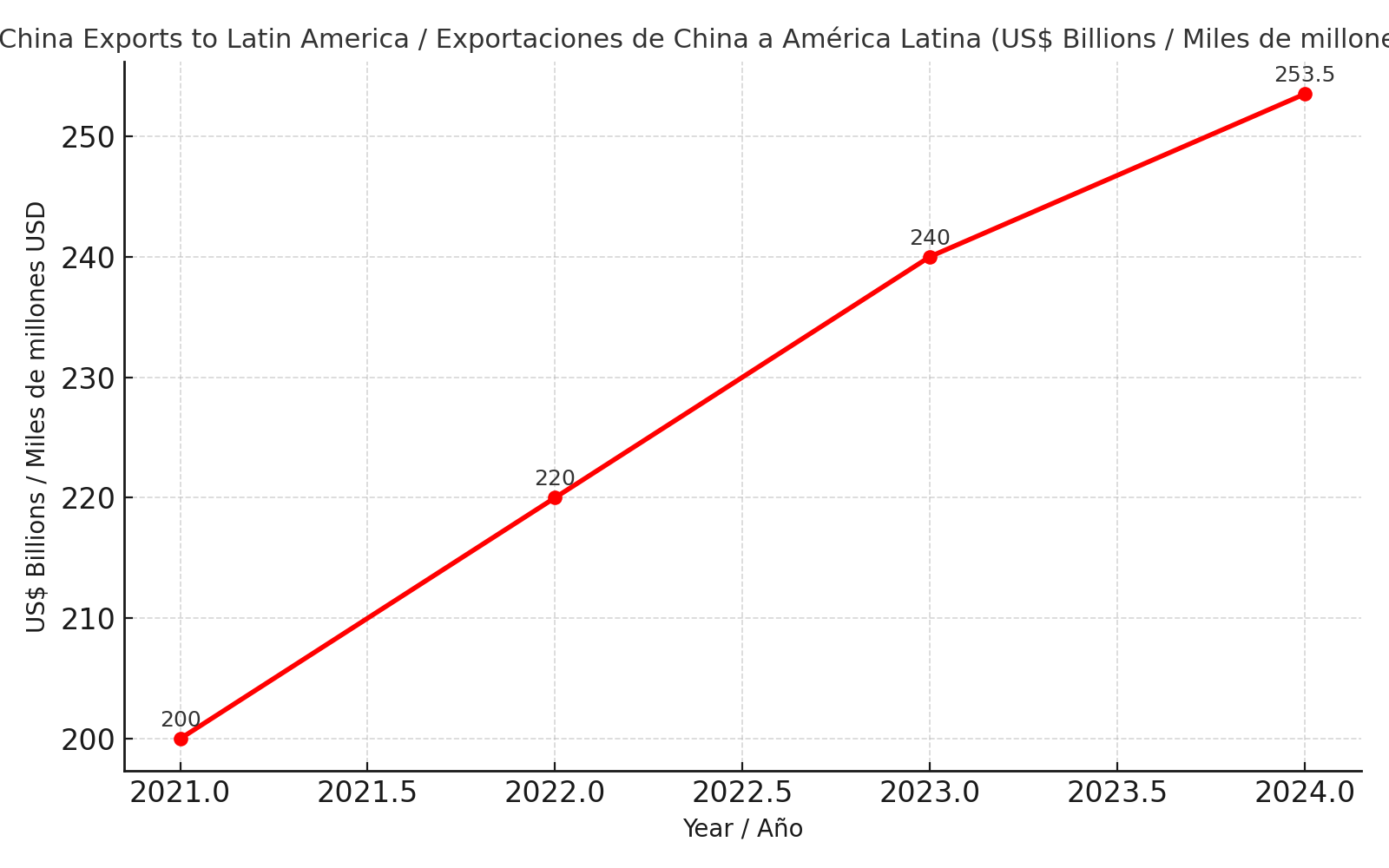
China has become a major trading partner for numerous Latin American economies.
That relationship can support exporters of minerals, agricultural products and other goods.
However, domestic manufacturers must also evaluate how increasing imports and international price pressure affect their competitiveness.
Both outcomes can occur simultaneously: an economy may benefit from international trade while particular industries face increasingly difficult conditions.
During 2026, United States officials and policymakers also expressed concerns about the strategic implications of Chinese participation in important infrastructure projects in Peru.
Those concerns deserve examination, but they do not demonstrate illegal commercial activity at the port or establish that its operator determines the retail prices of international marketplaces.
Manufacturing, maritime transportation and access to consumer markets are different but interconnected components of international competitiveness.
Context: Reuters reporting on Peru–China relations and increased U.S. scrutiny in January 2026.
5. The Risks for Your Wallet and Your Community
Our original investigation asked whether an apparently inexpensive purchase might have consequences beyond the immediate transaction.
That concern remains valid. However, the consequences must be evaluated with evidence rather than assuming that every low-price import automatically destroys jobs.
The Pressure on Local Manufacturers
When imported products consistently sell at prices domestic manufacturers struggle to reproduce, companies may lose sales, reduce investment, reorganize production or withdraw from particular markets.
Such outcomes are not inevitable. Productivity, taxation, technology, labor costs, exchange rates and product quality can explain substantial price differences.
Documented trade distortions, however, can intensify these pressures.
Updated Evidence: What Research Shows
The original edition included a table comparing Chinese exports to Latin America with annual manufacturing employment losses.
We have preserved the comparative format but replaced the employment estimates because their precise statistical attribution could not be established from the original references.
| Evidence | Documented Finding | Economic Significance |
|---|---|---|
|
Industrial Policy
IMF, 2025 | Main Chinese industrial-policy instruments estimated at approximately 4% of GDP annually in fiscal-equivalent cost. | Public support can influence production costs, investment and competitiveness in selected sectors. |
|
Steel Industry
OECD, 2026 | Median subsidy rate relative to assets approximately 15 times the reference producer level in 2024. | Documents substantial differences in industrial financial support. |
|
Steel Exports
OECD, 2026 | Approximately 131 million tonnes exported by China in 2025. | Illustrates the international scale of Chinese steel export capacity. |
|
Brazilian Textiles
Brazil, 2026 | Antidumping measures concerning selected polyester knitted fabrics, with application suspended on public-interest grounds. | Shows the tension between lower import costs and domestic industrial protection. |
Sources: IMF (2025), OECD (2026) and Brazilian trade-defense authorities (2026). These findings concern different sectors and do not constitute a single estimate of employment losses in Latin America.
The updated comparison separates documented economic mechanisms from broader consequences requiring country-specific and sector-specific analysis.
Brazil: When Producing Locally Becomes Difficult
Brazil provides an important example of the tensions between imported products, consumer demand and domestic manufacturing.
In February 2026, Reuters investigated the difficulties faced by a large international low-price fashion marketplace seeking to establish a local production network in Brazil.
Several manufacturers described pricing and delivery expectations that were difficult to sustain under local operating conditions.
Some producers withdrew from the initiative.
This does not demonstrate that every imported garment was sold below the cost of its materials.
Brazilian manufacturers face their own taxation, labor costs, logistics conditions and productivity challenges, all of which influence competitiveness.
Nevertheless, the experience raises an important question:
When Trade Requires Industrial Defense
Brazil has conducted trade-defense investigations involving certain textile imports from China.
In 2026, Brazilian authorities established definitive antidumping measures concerning selected polyester knitted fabrics, while suspending their application on public-interest grounds.
This illustrates a difficult economic balance.
Consumers and downstream businesses may benefit from lower-priced imports, while domestic manufacturers seek protection against substantiated unfair trade practices.
A decision concerning one product category must not be interpreted as evidence that all imports or international marketplaces operate illegally.
It does, however, demonstrate that specific concerns have been significant enough to trigger formal trade-defense procedures.
Consumption Financing and Purchasing Power
Retail prices are not the only incentives influencing purchasing decisions.
Installment services, deferred payments, coupons and financing arrangements can make imported products easier to purchase.
For households managing limited monthly income, dividing a payment may provide genuine flexibility.
At the same time, improved access to credit may stimulate additional demand.
Brazil’s customs rules distinguish between taxes collected at checkout under Remessa Conforme and payments made later under other eligible import procedures.
Paying import taxes later is not, by itself, a government-funded consumer loan.
Commercial credit must be examined separately, including who finances the purchase and under what terms.
The responsibility for addressing this challenge cannot rest on low-income consumers.
Affordable products are a legitimate necessity. Maintaining industrial competitiveness requires decisions by businesses, financial institutions and public authorities.
Japan: A Reflection on Industrial Resources
Japan faces different challenges as an advanced manufacturing economy.
Its trade in recovered copper provides an interesting example of the relationship between materials and industrial strategy.
According to WITS / World Bank statistics, Japan recorded the following trade in copper waste and scrap during 2025:
| Copper Waste and Scrap | Japan, 2025 |
|---|---|
| Total exports | 415,763 tonnes |
| Exports to China | 369,263 tonnes |
| Share exported to China | 88.8% |
| Total imports | 334,795 tonnes |
| Export value | Approximately US$3.37 billion |
| Import value | Approximately US$2.75 billion |
Source: WITS / World Bank, UN Comtrade, HS 7404, 2025. Shipment weights do not indicate identical recoverable copper content.
Japan also imports copper ores and concentrates from producing countries such as Chile and Peru to supply its metal-processing industry.
Ores, concentrates and scrap differ in composition, purity and processing requirements. Their weights cannot be treated as equivalent amounts of copper.
Simultaneous imports and exports of recovered materials may reflect industrial specifications, processing capacity, contracts and international prices.
Still, the figures raise a legitimate strategic question:
If Japan depends on imported industrial resources, how much additional value could it retain by processing more recovered materials domestically?
This is not an argument for automatically prohibiting exports.
It is a reflection on recycling technology, industrial capacity, resource security and long-term competitiveness.
Quality, Durability and Consumer Safety
A lower price does not necessarily mean inferior quality.
However, consumers should evaluate authenticity, product durability, safety standards, warranties and seller reliability before purchasing.
Counterfeit goods and unsafe products are genuine concerns in international commerce, but their prevalence requires product-specific testing and credible enforcement evidence.
It would be inaccurate to assume that all products from a particular country share the same risks.
A product that fails quickly or cannot be repaired may generate additional costs through repeated replacement.
That matters for household budgets and environmental sustainability.
6. What Future Are You Building with Your Purchases?
Buying an affordable product is not a moral failure.
For millions of families, managing household expenses is essential.
Nor should consumers be expected to personally compensate for weak industrial competitiveness or unequal access to financing.
However, societies should examine what happens when imported goods become progressively more competitive while domestic production becomes harder to maintain.
A factory is more than a building.
It supports suppliers, skilled workers, maintenance businesses, transport services and technical knowledge accumulated over time.
When industrial capabilities disappear, rebuilding them may require significant investment and many years.
That is why long-term competitiveness deserves attention alongside immediate consumer savings.
Price Is Not the Same as Value
Before purchasing an exceptionally inexpensive product, consider:
- Whether it is authentic and traceable.
- The quality and durability of its materials.
- Compliance with relevant safety standards.
- Warranty and repair possibilities.
- Shipping costs, taxes and import duties.
- Whether the advertised price is temporary.
- The reliability of the seller and manufacturer.
These considerations are especially important in the market for collectible figures and Japanese character merchandise.
An authentic collectible and an imitation of uncertain origin may look similar in a photograph, but they do not necessarily offer the same manufacturing standards, guarantees or collector value.
What Should Governments and Industries Do?
International trade can expand consumer choice, reduce costs and generate new opportunities.
Supporting domestic manufacturing should therefore not become an excuse to reject legitimate competition or indefinitely protect inefficient industries.
More effective responses may include:
- Investigating documented unfair trade practices under applicable rules.
- Improving access to productive financing and industrial technology.
- Investing in infrastructure, skills and advanced manufacturing.
- Supporting innovation and higher-value industrial products.
- Developing recycling and strategic-material capabilities.
- Diversifying supply chains and trading relationships.
The objective is not to prevent people from buying affordable imported products.
It is to preserve the capacity to produce, innovate and compete under conditions that can be evaluated transparently.
The Final Question: Cheap Today, Competitive Tomorrow?
China’s manufacturing competitiveness cannot be explained by a single factor.
Economies of scale, technology, supplier networks, private investment and public industrial policies all play different roles.
Yet international research demonstrates that certain subsidies and excess productive capacity can distort competition and affect industries beyond China’s borders.
Latin America must consider the relationship between affordable imports and productive development.
Japan must continue examining industrial competitiveness, resource security and the value generated by its advanced manufacturing capabilities.
For consumers, the lesson is not to reject every inexpensive offer.
It is to understand that the price on a screen may reveal only a small part of the economic system behind a product.
Real development means more than purchasing cheaply today.
It also means preserving the ability to manufacture, innovate and compete tomorrow.
Sources and Further Reading
The following documents support the principal research findings in the October 2026 update. Sector-specific findings should not be interpreted as universal conclusions about every Chinese export or international marketplace.
- International Monetary Fund (2025). Industrial Policy in China: Quantification and Impact on Misallocation. Read the IMF paper
- OECD (2026). Steel Outlook 2026. Read the OECD report
- Reuters (February 4, 2026). Investigation into the difficulties of establishing an international low-price fashion production network in Brazil. Read the investigation
- Brazilian Ministry of Development, Industry, Trade and Services (2026). Trade-defense proceedings involving polyester knitted fabrics. Official documentation
- Receita Federal, Brazil. International shopping and customs-tax procedures. Official guidance
- World Bank / WITS (2025). Japan’s exports of copper waste and scrap, HS 7404. Export statistics
- World Bank / WITS (2025). Japan’s imports of copper waste and scrap, HS 7404. Import statistics
- Reuters (January 27, 2026). Scandal tests Peru’s China ties as U.S. scrutiny intensifies. Read the reporting